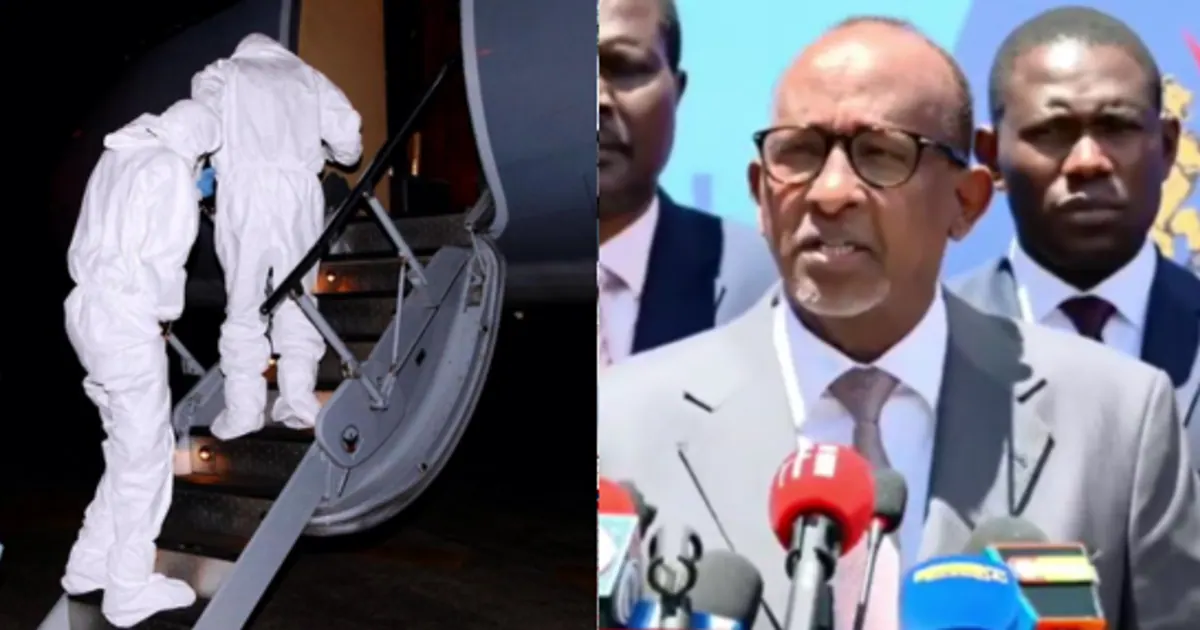
Kenya has started tracing and monitoring people who came into contact with the country's first confirmed Ebola patient after the Kenyan national died at a Nairobi hospital. Health Cabinet Secretary Aden Duale confirmed that the patient, a Kenyan citizen who had lived in the Democratic Republic of Congo (DRC) for seven years, died at about 11:30 pm on Monday. The patient had been receiving supportive treatment after being isolated at Nairobi Hospital.
According to CS Duale, authorities have identified 28 contacts, including family members and healthcare workers, who are being followed as part of the response. A further 23 passengers and four crew members who were on the same flight as the deceased are also being pursued. The patient had travelled by road from the DRC to Kampala, Uganda, before boarding Jambojet flight 8523 to Nairobi, where he underwent routine screening by Port Health officials.
The patient arrived at Jomo Kenyatta International Airport (JKIA) on Saturday at about 1:10 pm and was transported directly from JKIA by a relative and a friend to Nairobi Hospital. He was initially isolated in a separate room in the hospital's Accident and Emergency area before being transferred to the East Wing Isolation Facility. The facility was established during the Covid-19 pandemic and has isolation infrastructure, including intensive care and high-dependency facilities, as well as more than 145 beds.
The patient presented with fever, chills, intense fatigue, weakness, muscle pain, painful swallowing, sore throat, and bleeding under the skin at the injection sites. Given the symptoms and his travel history from the DRC, doctors suspected a viral haemorrhagic fever and collected samples for testing. The samples subsequently tested positive for Ebola, specifically the Bundibugyo virus disease.
The tests were conducted at both the National Virology Reference Laboratory, operated by the National Public Health Institute, and the Kenya Medical Research Institute (KEMRI) laboratory. The identification of 28 contacts marks the immediate containment phase following confirmation of the imported case. Those being monitored include members of the patient's family and healthcare workers who may have been exposed.
Ebola is transmitted through direct contact with blood or other bodily fluids of an infected person, including after death. People who are infected generally become contagious after developing symptoms. Kenya's response now depends heavily on identifying people who may have had close contact with the patient, monitoring them for symptoms, and isolating and testing anyone who develops signs consistent with Ebola.
The government had activated the National Ebola Incident Management System and strengthened surveillance at airports and land borders, laboratory testing, rapid response teams, and isolation facilities. More than 71,000 travellers had been screened by early June, and the government had designated 22 Ebola isolation units and received a five-tonne consignment of personal protective equipment, rapid diagnostic kits, infrared thermometers, and other supplies from India.
Key points
- 28 contacts identified as surveillance begins
- Patient had lived in DRC for seven years before travelling to Kenya
- Government strengthens national Ebola preparedness and strategic response capacity