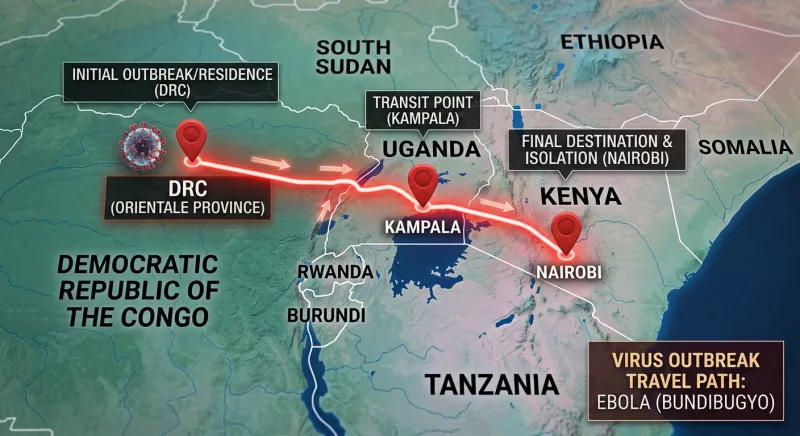
Kenyan health authorities have confirmed the country's first imported Ebola case, a Kenyan citizen who had been living in the Democratic Republic of Congo (DRC) for seven years. The patient traveled to Kenya after falling ill and receiving treatment at several hospitals in the DRC. According to the Ministry of Health, the patient arrived in Nairobi on Saturday, October 3, 2026, at 1:10 pm and underwent routine public health screening at Jomo Kenyatta International Airport.
The patient presented with symptoms including fever, chills, intense fatigue, and weakness, muscle pain, painful swallowing, sore throat, and bleeding under the skin at injection sites. He was quickly isolated in a separate room at Nairobi Hospital's accident and emergency department before being transferred to the East Wing Isolation Facility. The Ministry said the patient had fallen ill about a month earlier and had been treated at several hospitals in the DRC before traveling to Kenya.
Health authorities are tracing 23 passengers and four crew members who traveled on the same flight as the patient from DRC to Nairobi. The Ministry said arrangements are being made to quarantine those considered to be at risk. The patient later died after being placed on supportive treatment, prompting authorities to intensify contact tracing and other containment measures.
The Ministry of Health had maintained a high level of alert for Ebola since the outbreak began in May 2026. As of October 6, 2026, health authorities had screened 652,584 travelers and tested 267 samples across five laboratories. Only one test had returned positive. The Ministry said it had also trained 4,971 health workers at national and sub-national levels on Ebola prevention and management.
The World Health Organisation has been notified of the case in line with the International Health Regulations. The Ministry urged the public not to panic, saying measures were in place to contain the spread of the disease. It advised members of the public to maintain hand hygiene, avoid close contact with sick people arriving from countries reporting active Ebola transmission, and seek medical attention if unwell.
Before traveling to Nairobi, the patient had traveled from the DRC to Kampala by road. He was then transported directly from Jomo Kenyatta International Airport to Nairobi Hospital by a relative and a friend in a Toyota Fielder. The patient's travel history has become a key part of the public health response, with authorities tracing people who may have been exposed to the patient during his journey.
The Ministry of Health is working to contain the spread of the disease, with a focus on contact tracing and quarantine measures. The patient traveled on a flight with several other passengers, increasing the risk of transmission. Health authorities are working to identify and isolate any individuals who may have been exposed to the patient.
Key points
- The patient, a Kenyan citizen, had been living in the DRC for seven years before traveling to Kenya.
- Health authorities are tracing 23 passengers and four crew members who traveled on the same flight as the patient.
- The Ministry of Health has maintained a high level of alert for Ebola since the outbreak began in May 2026.