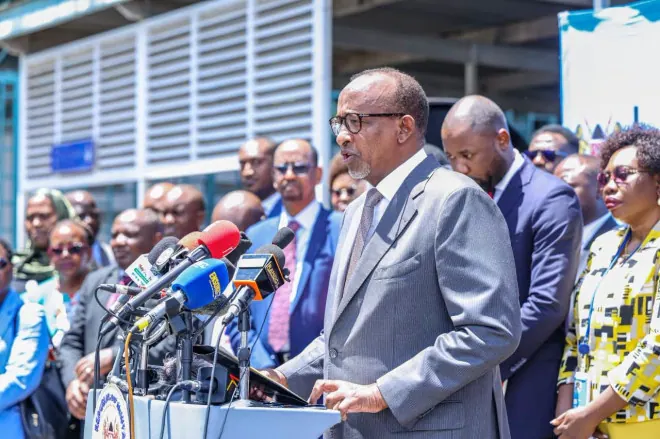
Kenya has confirmed its first case of Ebola, a Kenyan citizen who had been living in the Democratic Republic of Congo for seven years. The patient, who fell ill a month ago, was treated in several hospitals in DR Congo before traveling to Nairobi, where he died days after arrival. Health Minister Aden Duale announced the confirmation, stating that the patient had tested positive for the Bundibugyo species of Ebola.
The patient had traveled from DR Congo to Uganda and then boarded a flight to Nairobi, where he underwent normal public screening at the airport. He was then transferred to a hospital in the city by a relative. Duale stated that the patient developed symptoms such as fever, chills, and bleeding under the skin, prompting doctors to suspect a viral haemorrhagic fever. Samples were collected for testing, which confirmed the presence of Ebola Bundibugyo virus.
The current outbreak in DR Congo has been caused by the Bundibugyo species of Ebola, which is relatively rare and has no approved vaccine or treatment. However, four vaccines are in development, with human trials for one of them launched in July. The World Health Organization (WHO) has recorded 4,082 deaths out of 8,463 cases in the current outbreak, making it the largest ever recorded in DR Congo.
The patient died at 23:30 on Monday, and his burial is planned for later on Tuesday, in line with public health safety protocols. At least 28 contacts, including family members and healthcare workers, have been identified, while health authorities are tracing a further 23 passengers and four crew members who traveled on the same flight. A senior health ministry official suggested that the patient might have passed screening at the airport because the medication he was taking masked his symptoms.
Kenya introduced tighter checks at airports and border posts after the outbreak was declared in DR Congo. Health Minister Duale urged Kenyans not to panic, stating that all systems are in place to mitigate the spread of the disease. He also asked health workers to be extra vigilant and maintain the highest infection prevention and control measures.
The crisis in Eastern DR Congo, where Ebola was first discovered, has been exacerbated by decades of conflict, with multiple rebel groups operating in the region. The conflict has led to the death and displacement of millions of people, hampering the country's ability to develop and maintain functional healthcare systems and infrastructure. Medical charity Médecins Sans Frontières (MSF) believes the current toll could be even higher due to gaps in surveillance and testing.
MSF reported that the virus is spreading rapidly, with new hotspots emerging in North Kivu province, which borders Ituri where the virus began. The province now accounts for nearly 40% of all newly confirmed cases nationwide. The WHO and other health organizations are working to contain the outbreak, but the situation remains challenging due to the ongoing conflict and limited healthcare resources.
Key points
- The patient, a Kenyan citizen, had been living in DR Congo for seven years before traveling to Nairobi, where he died days after arrival.
- The current outbreak in DR Congo has killed over 4,000 people, making it the largest ever recorded in the country.
- Kenya has introduced tighter checks at airports and border posts to mitigate the spread of the disease.