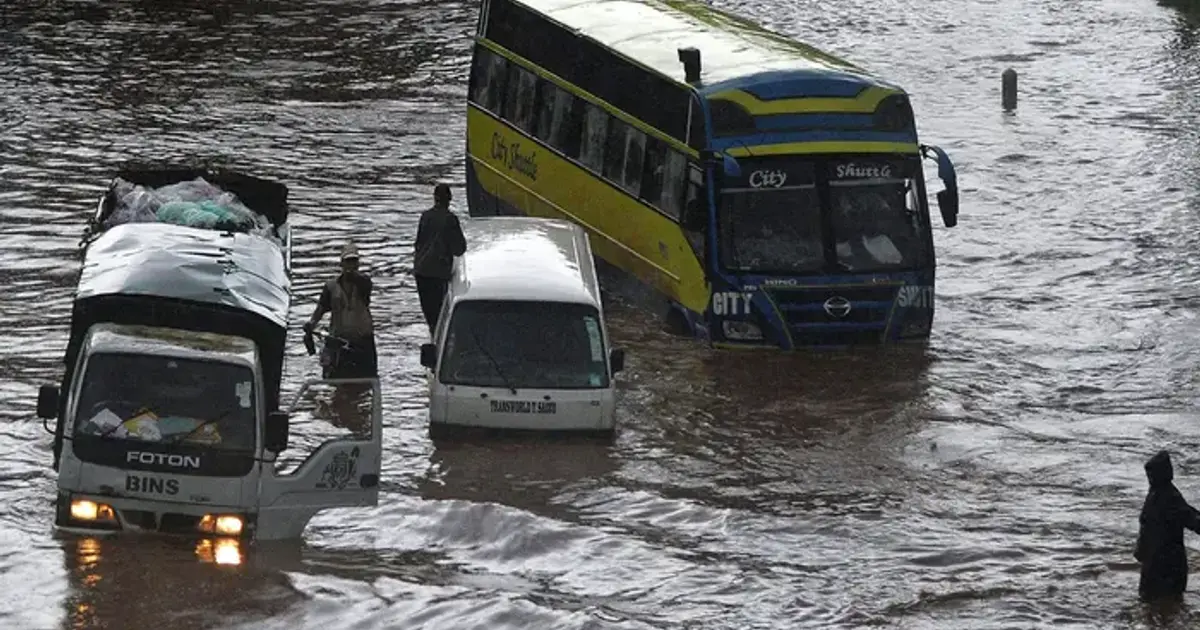
The Kenya Coast Guard Service (KCGS) has started pre-deployment and asset-readiness measures in high-risk flood zones across the nation's coastline, inland lakes, and shared waterways. This is in anticipation of the peak El Niño rainfall period. According to the Ministry of Interior, the maritime security agency is taking proactive steps to mitigate potential disasters and ensure rapid response capabilities along major water bodies.
The World Meteorological Organization (WMO) warns that sea-surface temperature anomalies in the central/eastern Pacific are projected to reach +3.7°C above normal during October–December 2026. This surpasses the previous record of +2.6°C set during the 2015–2016 event. The WMO's Global Seasonal Climate Update indicates that the current El Niño event is rapidly intensifying and is on track to become one of the strongest recorded since modern observations began in 1950.
The Kenya Coast Guard Service is focusing on critical risk zones, including the Tana River Delta, Garsen, the Lamu Archipelago, and Vanga and Shimoni in Kwale County. Key coastal urban waterways, such as Tudor and Port Reitz creeks in Mombasa, Kilifi Creek, and the Sabaki River, have been designated as primary concern areas. Specialized units and equipment are being strategically deployed to these areas to ensure preparedness.
Heightened preparedness efforts extend deep into the interior to safeguard communities along major inland water bodies. Search and rescue capacity is being reinforced across the Lake Victoria Basin, Lake Baringo, Lake Bogoria, Lake Naivasha, Lake Turkana, and along the Turkwel River. The KCGS has operationalized a centralized command facility at its regional headquarters to ensure seamless coordination and constant monitoring during the heavy rainfall season.
The measures come as national disaster management agencies coordinate multi-agency strategies to protect lives and property against expected heavy rainfall and potential flash flooding across susceptible regions. The WMO warns that the strengthening El Niño could break historical records by December. Global weather disruptions are expected, with altered rainfall patterns, severe drought, and elevated global temperatures.
WMO Secretary-General Celeste Saulo emphasized that early warnings and proactive climate adaptation strategies are critical to mitigating the risks to agriculture, water resources, public health, and infrastructure. The Kenya Coast Guard Service has established a dedicated Maritime Disaster Response Joint Operations Centre at its Headquarters in Mombasa to provide 24-hour monitoring and maintain operational links with the National Disaster Operations Centre.
The current climatic outlook is further complicated by interactions across adjacent ocean basins. The WMO highlights a concurrent positive Indian Ocean Dipole (IOD), a climate driver known to amplify rainfall extremes across the Indian Ocean basin. Simultaneously, sea-surface temperatures across the equatorial Atlantic remain significantly above average, creating a widespread web of warm ocean anomalies.
Key points
- The Kenya Coast Guard Service is taking proactive measures to mitigate potential disasters ahead of the El Niño peak in December.
- The WMO warns that the current El Niño event is rapidly intensifying and could break historical records by December.
- Global weather disruptions are expected, with altered rainfall patterns, severe drought, and elevated global temperatures.