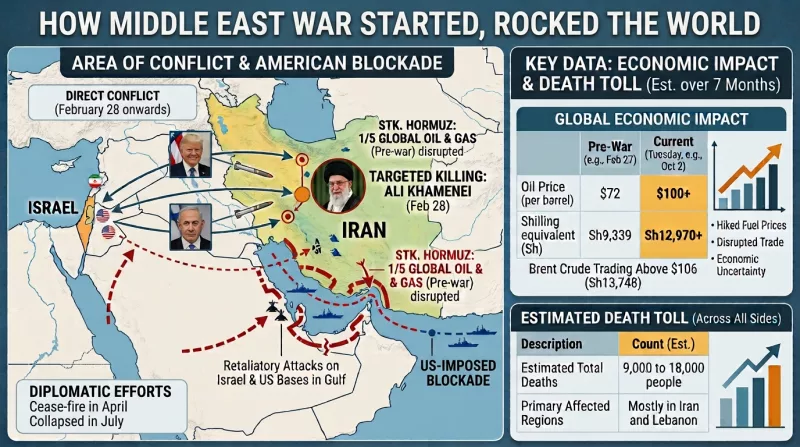
The ongoing conflict between Iran and Israel has significant implications for Kenya and the global economy. The war, which began in February, has resulted in the deaths of between 9,000 and 18,000 people across all sides, mostly in Iran and Lebanon. The conflict has disrupted trade, hiked fuel prices, and raised economic uncertainty worldwide. Kenya, as an importing nation, faces immediate transport, production, and household cost pressures.
The conflict has led to a significant increase in oil prices, with Brent crude trading above $106 per barrel, up from $72 before the war. This increase has far-reaching consequences for Kenya's economy, which relies heavily on imported oil. The country's Ambassador to Kenya, Dr. Ali Gholampour, attributed the conflict to Israel's expansionist policy and its attempts to dominate the Middle East. He emphasized that Iran's actions are driven by a desire to defend its sovereignty and maintain a peaceful nuclear program.
Eylon Levy, former spokesperson to Israeli Prime Minister Benjamin Netanyahu, offered a contrasting view, framing the conflict as a national security issue. He argued that Iran's nuclear and ballistic missile programs pose a significant threat to Israel's security and that the country must take measures to defend itself. Levy emphasized that Israel seeks stability and a reduced Iranian threat, recalling warm pre-1979 diplomatic relations between the two countries.
The conflict has also had a significant impact on global shipping, particularly in the Strait of Hormuz, which carries massive volumes of oil. Disruption to shipping in the strait has spiked energy and insurance costs worldwide. Dr. Gholampour stated that Iran historically allowed commercial shipping but restricted access after military operations were launched against it through the Gulf. He emphasized that vessels must coordinate with Iranian authorities to ensure safe passage.
The Israeli-Palestinian conflict is also a contentious issue, with Dr. Gholampour highlighting decades of Palestinian occupation and describing Gaza as "the largest open prison in the world." Levy, on the other hand, framed the issue around Israel's right to defend its citizens, proposing a solution based on the "three Ds": disarmament of Hamas, demilitarization of Gaza, and deradicalization of Palestinian society.
The conflict has sparked a war of words, with Israeli Prime Minister Benjamin Netanyahu predicting the eventual fall of Iran's government at the United Nations General Assembly. Dr. Gholampour rejected this claim, stating that the UNGA has been used by "genocidal regimes like Israel." Levy, however, emphasized that Israel desires stability and a significantly reduced Iranian threat.
As the conflict continues, Kenya and other importing nations face significant economic uncertainty. The country's economy is likely to be impacted by the rising oil prices and disruption to global trade. Key points to note include:
Key points
- The conflict between Iran and Israel has resulted in significant economic uncertainty for Kenya and the global economy.
- The war has disrupted trade, hiked fuel prices, and raised economic uncertainty worldwide.
- Kenya faces immediate transport, production, and household cost pressures due to its reliance on imported oil.