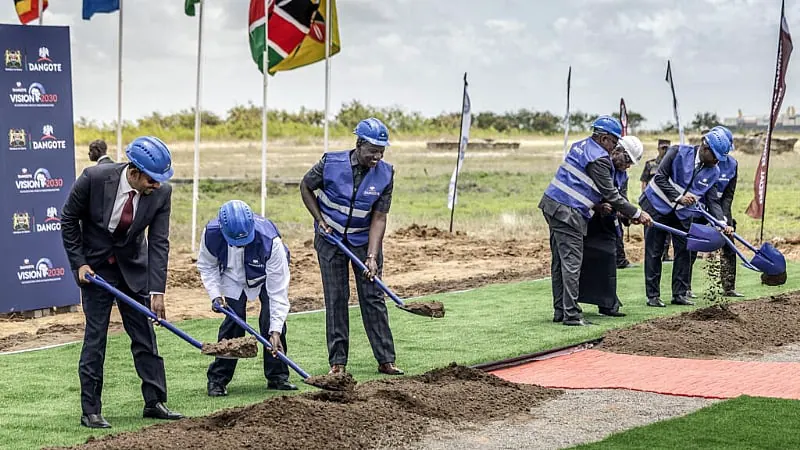
Kenyan President William Ruto and several African leaders, including Nigerian billionaire Aliko Dangote, attended the ground-breaking ceremony for the Dangote East Africa Petroleum Refinery at the Port of Lamu on September 30, 2026. The $16 billion refinery is expected to process 700,000 barrels of crude oil a day, producing petrol, diesel, and jet fuel for Kenya and markets across East Africa. Once completed, the refinery will be a significant addition to Africa's refining capacity.
Aliko Dangote presented the project as part of the solution to a long-standing paradox – an oil-producing continent that exports much of its crude while importing refined products. He stated that Africa cannot build lasting prosperity by exporting what it has and importing what it needs. The refinery is expected to help Africa become self-sufficient in fuel by 2030. According to figures cited by Ruto, Africa produced around 6.8 million barrels of crude oil a day in 2024 while consuming some 4.5 million barrels a day of refined petroleum products.
The refinery's location at a deep-water port is central to its strategy of importing crude by sea from the Middle East, the United States, and elsewhere, before potentially drawing more heavily on African producers as regional production expands. The complex will also include a 1,000-megawatt power facility built to supply the refinery, with excess output expected to feed into Kenya's electricity grid. This will help address Kenya's energy needs and support economic growth.
However, environmental groups have raised concerns over the project's potential impact on the region. The region is home to Lamu Old Town, a Unesco World Heritage site and one of the oldest surviving Swahili settlements in East Africa. Its coastline, islands, and mangrove forests are a major tourist attraction, while fishing remains central to the local economy. Local fishermen fear pollution could affect their catches, while residents are concerned that industrial development could hurt tourism.
Land rights have also become a flashpoint, with local residents going to court to ask that their rights to ancestral land be recognised before the development progresses further. According to Victor Abuso of RFI's Kiswahili service, residents say they were “not properly informed about this project and the negative effects that could come with it”. A court allowed Wednesday's ground-breaking ceremony to proceed while the legal case continues. Another hearing is scheduled on October 14.
The project also exposes persistent divisions within the East African Community, with governments pursuing competing oil and refining strategies. Uganda is preparing to exploit its own oil reserves and plans to build a smaller refinery in the district of Hoima, in the west of the country. Meanwhile, the East African Crude Oil Pipeline, or EACOP, is being built to carry Ugandan crude more than 1,400 kilometres to the Tanzanian port of Tanga.
Environmental and security concerns surround the project, with reports that Kenya could establish a dedicated military presence near the refinery to protect the facility and surrounding communities. Ruto has promised that land and environmental concerns will be dealt with “lawfully and fairly”. The project's success will depend on addressing these concerns and ensuring that the benefits of the refinery are shared equitably among local communities and the wider region.
Key points
- The Dangote East Africa Petroleum Refinery is expected to process 700,000 barrels of crude oil a day, producing petrol, diesel, and jet fuel for Kenya and markets across East Africa.
- The project has raised environmental concerns, particularly over the mangroves and the possibility of pollution reaching the Indian Ocean.
- The refinery's location at a deep-water port will allow it to import crude by sea from the Middle East, the United States, and elsewhere.