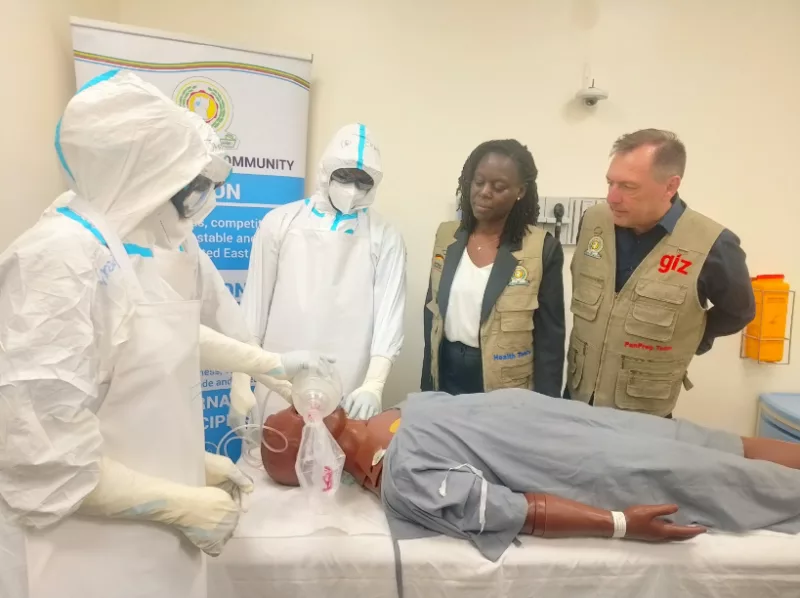
The East African Community (EAC) is investing in disease surveillance and frontline health capacity, with Kenya playing a central role in the regional effort to protect cross-border trade and supply chains from disruptions caused by infectious disease outbreaks. The EAC estimates that approximately $45 million (Sh5.8 billion) is required to effectively respond to Ebola and other viral haemorrhagic fever outbreaks in the region. The regional bloc has appealed to development partners and stakeholders to support regional preparedness and response efforts.
Diseases such as Ebola and Marburg pose an economic threat beyond the health sector, as millions of people and tonnes of goods move across East African borders every day. An outbreak that is not detected and contained early in one country can quickly spread to neighbouring markets, disrupting transport, trade, tourism, and business activity. The EAC is currently training 120 doctors, nurses, and other frontline health professionals from all eight Partner States in the management of high-consequence infectious diseases, including Ebola and Marburg.
The training, being held in Nairobi, is part of the Training in the East African Community for High-Consequence Infectious Diseases (tEACh) programme, an initiative of the EAC and German Agency for International Cooperation (GIZ). The programme brings together clinical experts from Charité – Universitätsmedizin Berlin, East African clinicians, representatives of national Emergency Operations Centres, and the World Health Organisation. The goal is to build specialised expertise within the region, equipping health professionals to detect, isolate, and manage cases while enabling them to train colleagues in their respective countries.
According to experts, stronger disease surveillance could reduce the risk of prolonged restrictions at border crossings and other points of entry, particularly for companies dependent on uninterrupted movement of cargo, employees, and customers. EAC acting director in charge of social sectors, Dorcas Omukhulu, said the regional training is building a common pool of health professionals with practical skills to detect, manage, and contain outbreaks while strengthening the ability of partner states to respond together when a public health emergency occurs.
The EAC has established a Mobile Laboratory Network comprising 10 laboratories across seven partner states, providing rapid diagnostic capacity at strategic locations and points of entry. The laboratories have supported responses to Ebola, Marburg, Covid-19, and Mpox. The EAC plans to more than triple the network to 34 mobile laboratories by the end of 2027, with additional support from Germany's Federal Ministry for Economic Cooperation and Development through KfW.
Germany has committed Sh724.8 million (€4.8 million) to scale up Ebola preparedness and response efforts. The funding will support the training of 500 frontline health workers, community sensitisation targeting 15,000 people in eastern Democratic Republic of Congo, procurement of 20,000 personal protective equipment sets, and support for registration of new Bundibugyo Ebola vaccines in EAC Partner States once approved by WHO. The programme is expected to leave each Partner State with trained trainers and critical care providers, reducing reliance on external expertise during future outbreaks.
Key points
- The EAC estimates that $45 million (Sh5.8 billion) is required to effectively respond to Ebola and other viral haemorrhagic fever outbreaks in the region.
- The EAC is training 120 doctors, nurses, and other frontline health professionals from all eight Partner States in the management of high-consequence infectious diseases.
- Germany has committed Sh724.8 million (€4.8 million) to scale up Ebola preparedness and response efforts in the region.