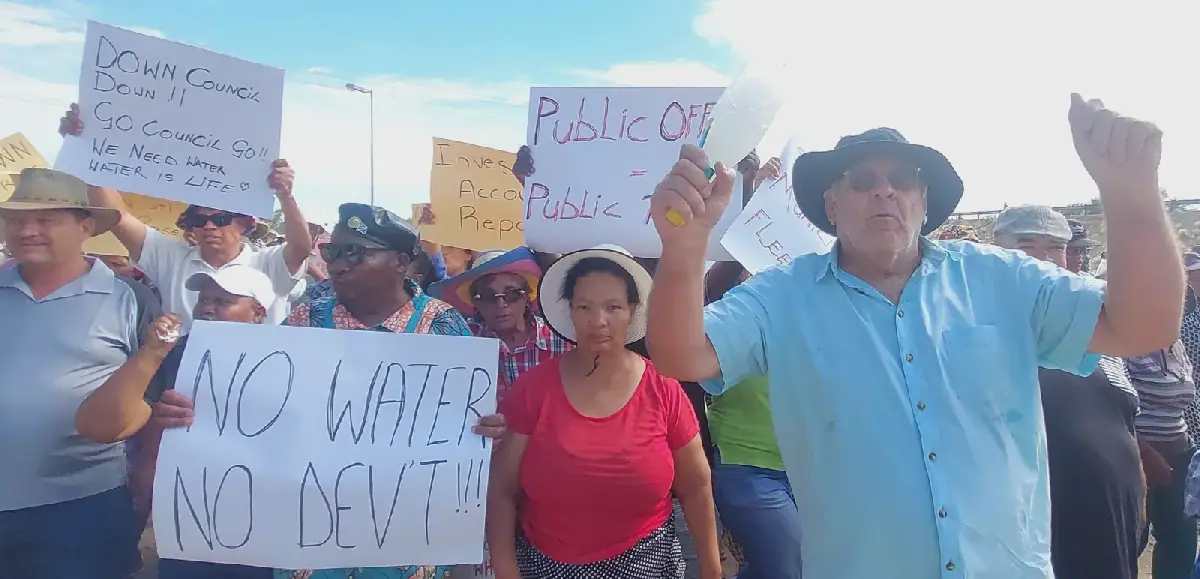
Residents of Keetmanshoop took to the streets this week to protest persistent water shortages in the town. The protest, which drew over 100 residents, saw demonstrators marching to the governor's office to demand an end to the water shortages and greater accountability from the municipality. A petition was handed to ǁKharas governor Dawid Gertze, addressed to urban and rural development minister James Sankwasa, calling for improved municipal services and financial transparency.
Governor Dawid Gertze addressed the protesters, attributing the water shortages to poor management and unpaid municipal accounts rather than a lack of water. He stated that there is enough water in the town, but the provision of water is being poorly managed, describing it as a "human-made problem." Gertze also mentioned that NamWater is not being paid by the respective authority responsible for protecting the town's interests.
Gertze urged the municipality to accept partial payments from residents towards their outstanding accounts. He assured residents that the water supply disruption on the day of the protest would be fixed quickly. The governor's comments come as Keetmanshoop struggles with a significant issue of non-payment of municipal bills by residents and other institutions.
Keetmanshoop mayor Emrico Blaauw provided further insight into the town's water challenges. He stated that only 30% of consumers pay their water accounts, leaving the municipality unable to meet its obligations to NamWater. The town consumes around N$1 million worth of water per week, with 70% of consumers not paying their bills.
The municipality has taken steps to address the issue, including deciding to forfeit royalties from one of its investments to free up funds to purchase water. The council is also installing prepaid water meters for consumers with substantial outstanding accounts, using government funding. Technicians are currently in the field, working to improve the prevailing situation.
The issue of non-payment of municipal bills is not limited to residents, with government institutions and schools also affected. Blaauw noted that those who pay on time are now also impacted by the water shortages. The municipality is working to find a solution to the problem, which has been ongoing for some time.
The protest and subsequent discussions with the governor highlight the need for greater accountability and improved municipal services in Keetmanshoop. The town's residents are demanding action to address the persistent water shortages and ensure that the municipality is managed effectively.
Key points
- Only 30% of Keetmanshoop consumers pay their water accounts.
- The town consumes around N$1 million worth of water per week.
- The municipality is installing prepaid water meters for consumers with outstanding accounts.
Reporting sources
- Thirsty Keetmanshoop protests Image - Namibian Sun · namibiansun.com