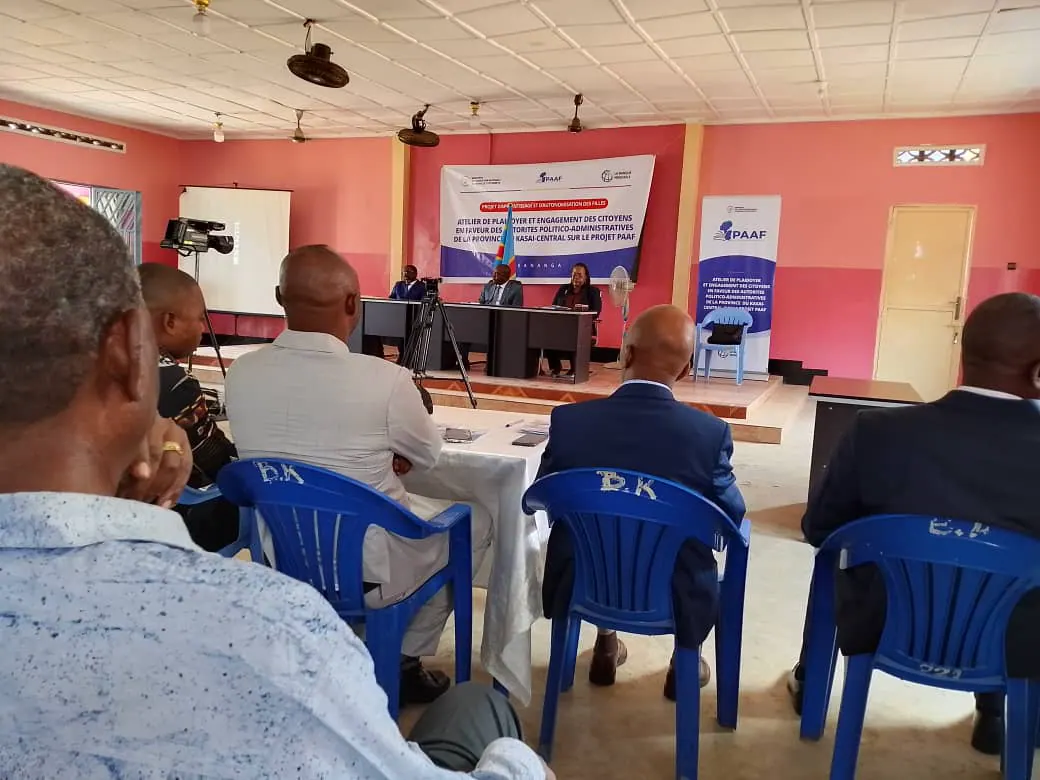
In the Democratic Republic of Congo, specifically in the province of Kasaï Central, a workshop was held to promote citizens' engagement with politico-administrative authorities. The event, organized by the Ministry of National Education and New Citizenship, took place on September 23, 2026, in Kananga, the provincial capital. The workshop aimed to present the stakes, vision, and institutional architecture of the Projet d'Apprentissage et d'Autonomisation des Filles (PAAF) in Kasaï Central.
The PAAF project, which came into effect on July 24, 2023, and will run until December 29, 2028, is financed by the World Bank to the tune of $400 million. Its objectives include increasing the number of girls enrolled in and completing secondary education, reducing disparities between men and women, and improving teaching and learning practices. The project's delegated coordinator recalled its goals and highlighted the challenges faced by girls in the DRC.
The representative of the Secretary-General of Education and New Citizenship thanked the provincial governor, Joseph-Moise Kambulu N'Konko, for supporting the event. He emphasized the transformation of the education system under the visionary leadership of President Félix-Antoine Tshisekedi Tshilombo and noted that educating a girl can transform an entire community. He called on education stakeholders to contribute to the project's success.
In his opening speech, Governor Joseph-Moise Kambulu N'Konko paid tribute to the Head of State for his commitment to education and championing positive masculinity. He vowed not to tolerate any obstacles to the project's implementation in his province and urged everyone to work towards the emancipation of young girls.
The workshop brought together various stakeholders to pledge their support for the PAAF project. The provincial government, education officials, and citizens are now united in their efforts to promote girls' education in Kasaï Central. The project's success will depend on the collaboration and commitment of all parties involved.
The PAAF project's focus on empowering girls through education aligns with the Congolese government's priorities. By investing in girls' education, the government aims to reduce disparities and promote sustainable development. The project's outcomes will be closely monitored, and its impact is expected to be felt in the long term.
The event in Kananga marked an important milestone in the PAAF project's implementation in Kasaï Central. With the support of the provincial authorities and education stakeholders, the project is poised to make a positive impact on girls' education in the region. Key outcomes will include increased enrollment and completion rates for girls in secondary education.
Key points
- The PAAF project aims to increase the number of girls enrolled in and completing secondary education in the DRC.
- The project is financed by the World Bank to the tune of $400 million over five years.
- The project's success depends on the collaboration and commitment of all stakeholders, including the provincial government, education officials, and citizens.