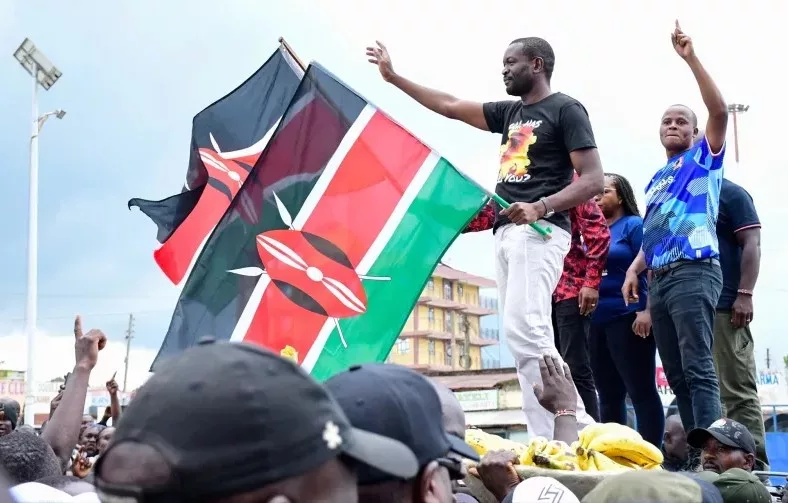
Nairobi Senator Edwin Sifuna has emerged as a key player in the quest for Luhya unity, a goal that has eluded several leaders in the past. Sifuna, who is from the Western region, is charting a singular path with apparent national appeal. He is not alone in this quest, as three other leaders, Masinde Muliro, Kijana Wamalwa, and Musalia Mudavadi, have preceded him. All these leaders have sought to rally voters to a single purpose, with the ultimate goal of uniting the Luhya community.
The Luhya community, which comprises several sub-tribes, constitutes a significant proportion of the national population. The quest for unity among the Luhya people comes up with recurrent urgency at every general election cycle. Masinde Muliro, one of the pioneers of the Luhya unity quest, teamed up with opposition doyen Jaramogi Oginga Odinga to form Ford in 1992. Muliro was a firebrand who initially belonged to the colonial government-backed KADU and later became a pillar of KANU in Western.
Kijana Wamalwa, who inherited Muliro's legacy, was instrumental in opposition unity and was considered the quintessential peacemaker and bridge between antagonistic forces in the opposition movement. Wamalwa's liberal streak made him acceptable to almost all sides of the political divide, leading to his elevation as the seventh vice president of the republic under Kibaki. The Luhya community united solidly behind Wamalwa in 2002, delivering a decisive victory for NARC against the government's onslaught.
However, Wamalwa's successor, Moody Awori, could not properly fill the void left by Wamalwa's demise, giving Mudavadi room to make a strong comeback through ODM. Mudavadi became a leading member of the ODM Pentagon and vice president-designate under Raila Odinga. He served as deputy prime minister and in charge of local government, exercising immense influence and operating as the undisputed political leader of the Western region.
Mudavadi's fortunes changed when he ditched his partnership with Raila and ran for the presidency in 2013, coming a distant third after Raila in a poll won by the Jubilee coalition of Uhuru and William Ruto. He rejoined Raila in 2017 under NASA but controversially lost the election. During Raila's last attempt in 2022, Mudavadi teamed up with Ruto under the Kenya Kwanza coalition, a move that has been seen as a flip-flop by his critics.
Sifuna's quest for Luhya unity faces stiff competition from Wamalwa and Mudavadi, who have both served as vice presidents during their political careers. Wamalwa and Mudavadi have a pedigree that includes serving as key players in opposition unity movements in the past. Sifuna will need to navigate the complex web of alliances and rivalries in the Luhya community to emerge as a unifying force.
The question on many people's minds is whether Sifuna will surpass Wamalwa or Mudavadi in his quest for Luhya unity. While Sifuna has shown national appeal, his ability to unite the Luhya community remains to be seen. With the general election cycle approaching, Sifuna's efforts will be closely watched by political analysts and Luhya leaders alike.
Key points
- Sifuna faces stiff competition from Wamalwa and Mudavadi in bid to unite Luhya community
- The Luhya community constitutes a significant proportion of the national population
- Several leaders have sought to rally voters to a single purpose, with the ultimate goal of uniting the Luhya community