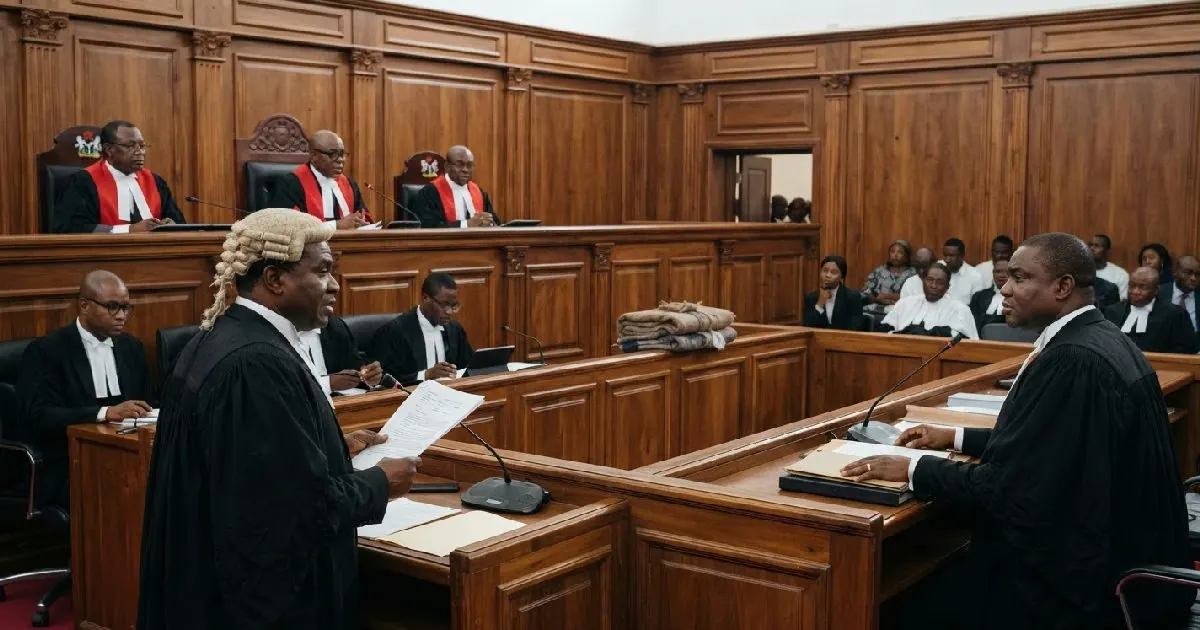
On May 9, 1979, a disturbing scene unfolded at 13 Dawaki Road in Nasarawa, Kano, as the wife of businessman Nafiu Rabiu, Hajiya Fati Mohammadu Nafiu, was found dead. Her death sparked a chain of events that led to the disappearance of a bundle of soiled blankets and clothes, and a subsequent legal battle that reached Nigeria's Supreme Court. Nafiu Rabiu, a member of a prominent Kano family, was tried and acquitted in the High Court, but the Kano State Government appealed the decision.
The evening of May 8, 1979, had been normal, with Nafiu, Fati, and three friends, including the District Head of Jahun, sharing dinner at their home. However, the next morning, the domestic facade crumbled when the cook found the main gate still locked. Nafiu Rabiu appeared at a window, throwing down the gate key, and instructed the cook to open the kitchen door, claiming he had misplaced his own key. He then emerged carrying a briefcase and the bundle of soiled blankets and clothes.
The driver of Nafiu Rabiu's Peugeot 504 was instructed to place the items in the boot, but when he checked the boot later, they were gone. The Supreme Court judgment recorded this unexplained disappearance without establishing their contents or ultimate fate. Later that afternoon, Nafiu's children discovered Fati unresponsive in her room, and Dr. Bansi Badan Tribedi, a senior consultant pathologist, identified the cause of death as asphyxia from strangulation, with multiple external injuries noted.
Despite this medical evidence, Nafiu Rabiu maintained his wife died peacefully in her sleep. The High Court of Kano State acquitted him, citing "conflicting and unsatisfactory" medical evidence. This decision sparked public outrage across Nigeria, particularly in Kano, where many believed that the influence of Rabiu's powerful family had swayed the judicial outcome.
The Kano State Government appealed the acquittal, and the Federal Court of Appeal reversed the decision, convicting Nafiu of culpable homicide not punishable with death and sentencing him to four years' imprisonment. Nafiu Rabiu took his case to the Supreme Court of Nigeria, which delivered its judgment on November 21, 1980, ruling that prosecutorial appeals against acquittals were permissible, but confined to points of law.
The Supreme Court found "serious problems" with the High Court judge's interpretation of Dr. Tribedi's medical evidence, identifying a "serious misdirection." This principle became crucial: a factual finding could constitute an error of law if "no reasonable tribunal" could have reached it. The Supreme Court ultimately upheld the Federal Court of Appeal's conviction, affirming the four-year sentence for culpable homicide.
Nafiu Rabiu served his term, spending four years in prison. His case remains a pivotal reference in Nigerian constitutional and criminal law, particularly regarding the appellate process and judicial review of evidence. The case offers a stark illustration of how Nigeria's legal system navigates the complex interplay of power, public sentiment, and established judicial process.
Key points
- The Supreme Court's judgment set a landmark precedent for Nigeria's judiciary.
- The case highlighted the importance of judicial review of evidence.
- The disappearance of the soiled blankets and clothes remains unresolved.