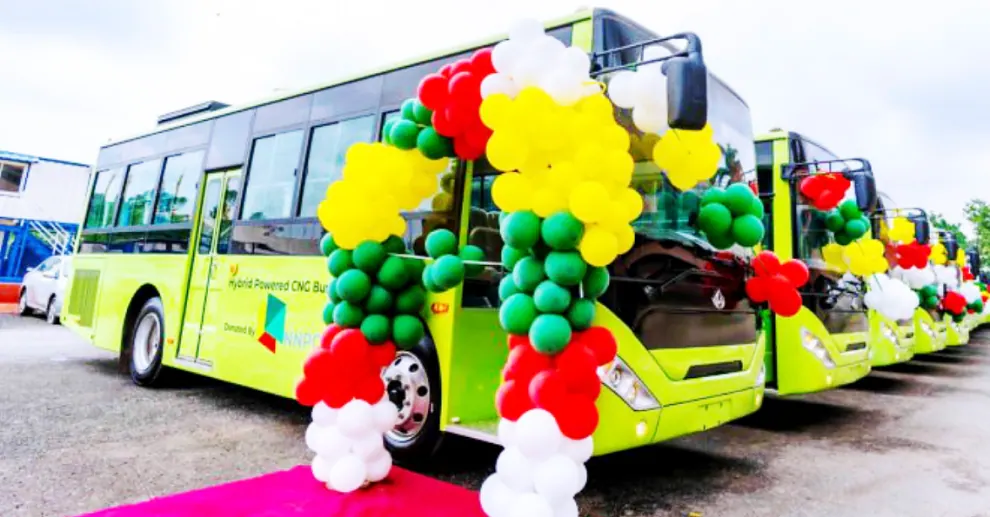
Several Nigerian states have started rolling out Compressed Natural Gas (CNG) buses to provide cheaper public transportation options for residents. This move is in line with the federal government's directive to reduce transportation costs and dependence on expensive traditional fuel systems. President Bola Tinubu had, on September 18, asked state governments to accelerate the deployment of CNG and electric mass transit systems to deliver measurable reductions in transportation fares from October 1.
Kano State, which launched 222 CNG and electric vehicles for public transportation in May, has been joined by Akwa Ibom and Cross River states, which have deployed 50 and 10 buses, respectively. Other states, including Ondo, Delta, and Edo, are also in the process of deploying CNG buses. According to reports, over 120,000 vehicles have already been converted to CNG under the National Affordable CNG Transit Programme, with over 400 certified conversion centers and more than 90 CNG refueling stations operational across the states and the Federal Capital Territory.
The Vice President, Kashim Shettima, who represented President Tinubu at the launch of the vehicles in Kano, said the initiative aimed to build a more resilient and economically competitive Nigeria. He noted that the adoption of CNG and electric mobility had become necessary to reduce transportation costs and lessen dependence on expensive traditional fuel systems. Shettima commended the leadership of PI-CNG & EV for driving the program and expanding its mandate to include electric vehicles.
In Akwa Ibom, Information Commissioner Aniekan Umanah said the CNG buses were operational in the state's 31 local government areas to ease public transportation. He stated that Governor Umo Eno was committed to implementing his ARISE Agenda, which includes easing the transportation burden faced by residents. The CNG buses were introduced to mitigate the effects of the removal of fuel subsidies by the federal government.
In Cross River State, Transport Commissioner Kingsley Egomi said the state government had 10 CNG buses for the takeoff of the initiative. He stated that further details would unfold in due course, adding that the intervention aimed to reduce transportation costs. The state government has started the conversion of vehicles to CNG and has also acquired electronic vehicles.
Other states, including Abia and Benue, are also making progress in implementing the CNG bus initiative. Abia State plans to increase its CNG bus fleet to 60 by the end of the year, while Benue State has placed an order for more buses, including CNG vehicles, for public transportation. The Benue State Government said it was working round the clock to make the scheme a success in the state.
The rollout of CNG buses is expected to have a positive impact on the economy and the lives of ordinary Nigerians. According to President Tinubu, Nigeria, as a gas-rich country, must insulate itself from volatility in the international energy market by expanding cheaper domestic alternatives rather than reverting to petrol subsidies. The CNG bus initiative is seen as a step in the right direction towards achieving this goal.
Key points
- President Bola Tinubu directed state governments to accelerate the deployment of CNG and electric mass transit systems to deliver measurable reductions in transportation fares from October 1.
- Over 120,000 vehicles have already been converted to CNG under the National Affordable CNG Transit Programme.
- Several states, including Kano, Akwa Ibom, and Cross River, have begun deploying CNG buses to provide cheaper public transportation options for residents.