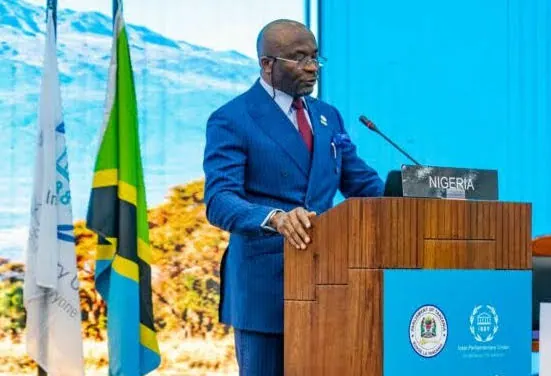
Deputy Speaker of the House of Representatives, Benjamin Kalu, has urged for coordinated legislative action worldwide to mobilize investment in climate projects and strengthen the resilience of communities exposed to flooding, food insecurity, and other climate-related disasters. This call was made during a debate on "Urgent Parliamentary Action to Address Climate-related Disasters and Strengthen Resilience" at the 153rd Assembly of the Inter-Parliamentary Union (IPU) in Arusha, Tanzania. The assembly, hosted by Tanzania's National Assembly, took place from October 5 to 9.
Kalu proposed a two-pillar intervention: developing a pipeline of investment-ready projects in key sectors and establishing a platform to help viable projects secure financing and progress to implementation. He emphasized that parliamentary debates must move beyond pledges to practical measures that attract financing and translate climate commitments into infrastructure, jobs, and protection for vulnerable populations. According to Kalu, this structured legislative intervention is necessary to address the consequences of climate change disrupting livelihoods, weakening food production, and placing pressure on communities and infrastructure.
The consequences of climate change are already being felt globally, with farmers confronting irregular rainfall and declining yields, coastal communities facing erosion and rising waters, businesses losing productive hours to unreliable energy, and cities struggling with flooding that overwhelms drainage systems and infrastructure. Kalu stressed that climate finance must support both emissions reduction and human resilience. He urged lawmakers to use legislation to create the legal certainty and public accountability required to support resilient and sustainable economies.
Kalu emphasized that legislation must not remain a statement of intent but become an instrument of delivery. He highlighted Nigeria's climate priorities, which must be measured by their impact on farming, electricity supply, employment, urban safety, and industrial development. For Nigeria, climate action is not an abstract environmental aspiration but about addressing the practical challenges faced by its citizens.
The deputy speaker's proposal aims to support the development of an investor-ready pipeline of priority projects across clean energy, transport, agriculture, resilient infrastructure, and the circular economy. He also suggested establishing a project-preparation and transaction-support platform that helps move viable projects from concept to bankability, financing, and implementation. This platform would facilitate the transition of projects from concept to reality.
Kalu's call for action emphasizes the need for legislators to take concrete steps to address climate-related disasters and strengthen resilience. He noted that the current situation demands more than just discussions and pledges; it requires practical measures that can be implemented to make a tangible difference. The proposed intervention aims to bridge the gap between climate commitments and actual implementation.
The 153rd Assembly of the Inter-Parliamentary Union (IPU) provided a platform for Kalu to share his perspectives with a global audience of lawmakers. His proposal for a structured legislative intervention across the globe aims to address the pressing issues of climate change and its impacts on communities. The assembly served as an opportunity for delegates to engage in discussions and explore potential solutions to climate-related challenges.
Key points
- Deputy Speaker Benjamin Kalu calls for global legislative action to mobilize investment in climate projects.
- Kalu proposes a two-pillar intervention to support climate projects.
- The proposal aims to translate climate commitments into infrastructure, jobs, and protection for vulnerable populations.