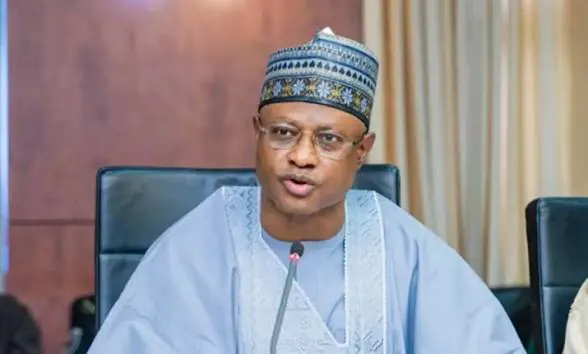
Governor Uba Sani of Kaduna State has been prioritizing governance within the law since assuming office in May 2023. With a background as a civil rights and pro-democracy activist, Presidential Adviser, and Political Adviser, he has a deep understanding of the importance of due process and the rule of law. As a senator in the upper legislative chamber, he contributed to law-making, and now, as governor, he has assented to 32 laws covering various sectors, including security, education, healthcare, and agriculture.
Security remains a top priority for Governor Uba Sani's administration, with a focus on sustainable development through peace and public safety. The administration has strengthened the Kaduna Vigilance Service (KADVS) by recruiting and training 7,000 personnel and providing security agencies with 150 Hilux vehicles and 500 patrol motorcycles. A forensic laboratory and training centre have also been constructed. The Kaduna Peace Model, which promotes dialogue and community-based peacebuilding, has been instrumental in improving security in areas such as Birnin Gwari, Chikun, and Giwa.
Governor Uba Sani's Rural Transformation agenda has initiated and executed approximately 150 road projects, covering over 1,300 kilometres across the 23 local government areas. The projects include urban roads, rural access roads, and strategic links connecting communities, agricultural production centres, and markets. Notably, the Gadan-Gayam–Gwaraji–Kujama road network, which spans across three local government areas, has connected approximately 76 farming communities.
Education is a key focus area for Governor Uba Sani, who considers it a right, not a privilege. His administration has constructed 736 new classrooms, renovated over 1,200 existing classrooms, and recruited 10,000 new teachers. Over 33,000 education personnel have received training in modern teaching methods and digital skills. The number of out-of-school children has decreased from approximately 550,000 to 187,720.
Governor Uba Sani has also strengthened secondary and tertiary education in Kaduna State. New secondary schools and science schools have been established, while existing ones have been renovated and upgraded. The reduction of tuition fees in state-owned tertiary institutions has led to increased student enrolment. At Kaduna State University (KASU), the governor has released over ₦800 million for staff welfare and ₦146 million to clear withheld salaries and outstanding SIWES allowances.
In addition to formal education, Governor Uba Sani has invested in skills-based education through the Institute of Vocational Training and Skills Development. The institute, with campuses in Soba, Rigachikun, and Saminaka, focuses on practical skills in areas such as ICT, mechatronics, and renewable energy. Recently, the institute graduated over 4,000 artisans and tradespeople, who received ₦200,000 each to support their transition to productive work.
Governor Uba Sani's administration has also made significant investments in healthcare, with a focus on providing quality healthcare services to the people of Kaduna State. While specific details on healthcare investments are limited, the governor's emphasis on human capital development and overall well-being suggests a comprehensive approach to addressing the state's healthcare needs.
Key points
- Governor Uba Sani has assented to 32 laws covering various sectors in Kaduna State.
- The administration has prioritized security, with a focus on sustainable development through peace and public safety.
- Over 4,000 artisans and tradespeople have graduated from the Institute of Vocational Training and Skills Development.