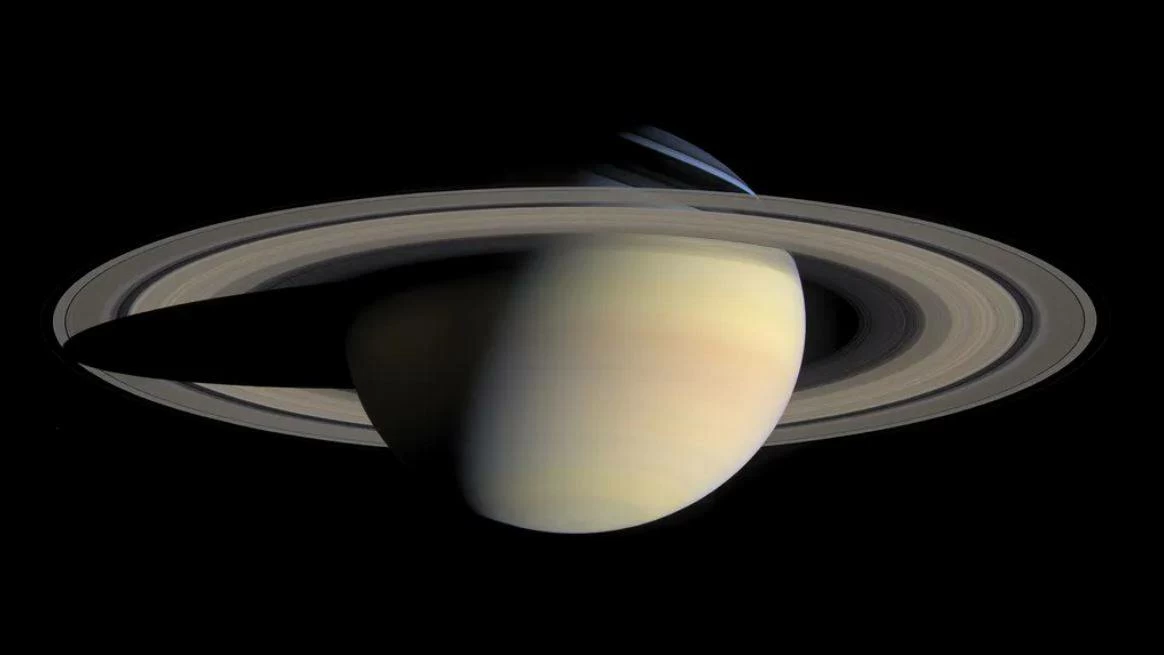
The planet Saturn is set to reach its annual "opposition" stage next week, making it visible to the naked eye as a bright, fixed point in the sky. This phenomenon occurs when the Earth passes between Saturn and the sun, placing both celestial bodies on the same side of the solar system. As a result, Saturn will appear in the sky directly opposite the sun, similar to a full moon.
On Sunday, October 4, Saturn will reach its opposition, making the weeks leading up to and following this date ideal for viewing. At a distance of approximately 784 million miles (1.26 billion kilometers) from Earth, Saturn's disk will appear at its largest possible size when viewed through a telescope. Its pale yellow light will also shine with a stronger brilliance compared to other times of the year.
Fortunately, no special equipment is required to spot Saturn, as it will be visible to the naked eye in the clear sky as a bright, fixed point between the constellations Pisces and Cetus. According to Live Science, this makes it an excellent opportunity for stargazers to observe the planet.
Coinciding with this event, the National Institute for Astronomical and Geophysical Research, led by Dr. Bassem Nabawi, will participate in a unified Arab event to observe Saturn today, Friday. The event is part of the global initiative "100 Hours of Astronomy," which takes place under the theme "A New Perspective on Our Solar System."
Dr. Samia Saad, supervisor of the International Astronomy Education Center at the institute, stated that a specialized team from the astronomy department will participate in monitoring, photographing, and documenting the phenomenon. The observation will be conducted at various locations, including the College of Sciences at South Valley University in Qena and the Regional Center of the institute in the New Valley.
The observation of Saturn is part of a broader educational program organized by the institute during October, which includes scientific and interactive activities at the Children's Museum in New Cairo. The program also features astronomical activities in collaboration with Khalid bin Al-Walid Library, aiming to provide opportunities for the public, especially children and youth, to learn about astronomy and space.
Majid Abu Zahra, head of the Jeddah Astronomical Society, stated that Saturn can be seen with the naked eye as a luminous object with a yellowish hue. Small telescopes can reveal its famous rings, and some of its moons may appear as small points of light nearby. He recommended the best time for observing Saturn to be about an hour or two after sunset, when the planet is above the horizon, reducing the impact of atmospheric disturbances.
Key points
- The planet Saturn will be visible to the naked eye in Egypt next Sunday as it reaches its brightest and largest size of the year.