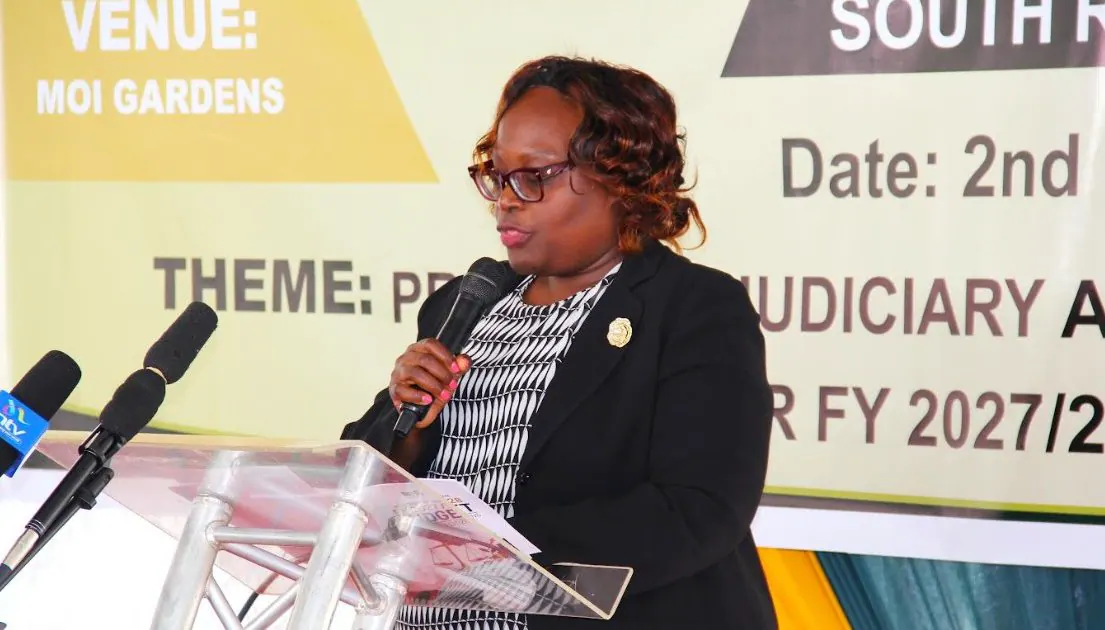
The Judiciary in Kenya has proposed a budget of Sh50.7 billion for the 2027/2028 financial year. This allocation aims to expand access to justice, increase court capacity, accelerate case resolution, and strengthen the institution's ability to meet growing demand for judicial services. The proposed budget faces a financing gap of approximately Sh20.4 billion due to an indicative budget ceiling of Sh30.4 billion. This gap could impact the implementation of planned programs and capital investments.
A public participation forum was held in Kericho as part of the budget-making process. The forum allowed members of the public to scrutinize the proposed Judiciary and Judicial Service Commission budget for the 2027/2028 financial year. The exercise aimed to gather views on expenditure priorities, resource requirements, and planned investments in the justice sector. Registrar of the Environment and Land Court, Rose Wakungu, delivered a speech on behalf of Chief Registrar of the Judiciary, Winfridah Mokaya.
The proposed budget allocates Sh46.2 billion for recurrent expenditure and Sh4.5 billion for development programs. These programs cover court operations, human resource requirements, infrastructure, digitization, information technology, cybersecurity, and other investments aimed at improving justice delivery. The Judiciary's constitutional obligation to uphold openness, accountability, and public participation in managing public finances includes presenting the proposed budget to the public.
The Judicial Service Commission has proposed a budget of Sh1.83 billion to discharge its constitutional mandate. However, it faces an indicative allocation of Sh1.038 billion, leaving a funding gap of approximately Sh795 million. This gap could impact the commission's ability to establish new courts, widen physical access to justice, modernize digital systems, and recruit personnel. Resource constraints have a direct bearing on the judiciary's ability to address case backlog, delays in dispute determination, and long distances to court stations.
The Judiciary has made efforts to expand access to justice, including operationalizing new law courts and increasing the number of magistrates' courts. Four new law courts were operationalized during the last financial year, and nine more courts have been lined up for operationalization in the current financial year. The number of magistrates' courts rose from 143 to 148, while small claims courts increased from 40 to 55. Additionally, 1,182 judicial staff, 124 additional magistrates, and 53 judges were recruited to strengthen institutional capacity.
The Judiciary has demonstrated improved case disposal performance, resolving 576,162 cases during the 2025/2026 financial year against 561,580 new cases filed. This performance produced a case clearance rate of 103 percent, meaning courts concluded more matters than were filed during the year. Digital transformation has become an increasingly important component of efforts to improve efficiency, reduce administrative bottlenecks, and make judicial services more accessible.
The Judiciary's digital transformation initiatives include automation of processes such as succession and the use of the Case Tracking System and e-Judiciary portal. The Mahakama Popote platform enables judicial capacity to be virtually deployed across court stations experiencing heavier caseloads. A total of 22,516 matters were resolved through Mahakama Popote during the last financial year. Sustaining such interventions will require adequate and predictable financing as demand for judicial services grows.
Key points
- The Judiciary faces a financing gap of approximately Sh20.4 billion due to an indicative budget ceiling of Sh30.4 billion.
- The proposed budget allocates Sh46.2 billion for recurrent expenditure and Sh4.5 billion for development programs.
- The Judiciary has demonstrated improved case disposal performance, resolving 576,162 cases during the 2025/2026 financial year.