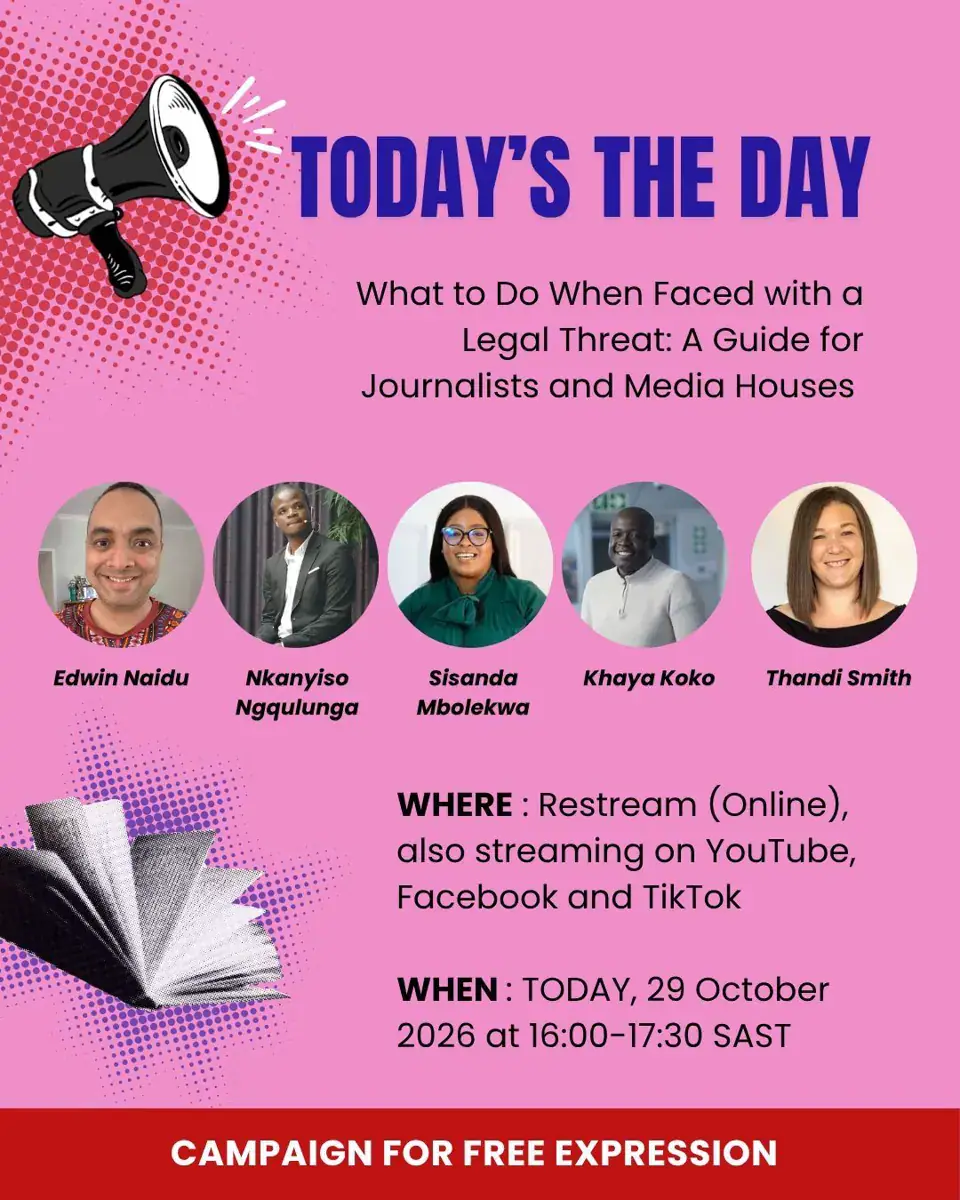
Journalists in South Africa are facing increasing threats and intimidation from powerful individuals and institutions, with many using court processes to discourage public-interest journalism. A recent online webinar hosted by the Campaign for Free Expression (CFE) discussed the growing use of protection orders, lawsuits, and harassment against media professionals. The webinar, titled "What to Do When Faced with a Legal Threat: A Guide for Journalists and Media Houses," brought together several experienced journalists and legal experts.
The webinar highlighted the financial, emotional, and professional consequences of legal action against journalists. Sisanda Mbolekwa, a Sunday Times political reporter, shared her experience of receiving an interim protection order following her investigations into the National Youth Development Agency (NYDA). The order prevented her from contacting the agency's executive chairperson, sending questions, or publishing information about her without consent. Mbolekwa described the experience as "chilling," saying that she could have ended up in prison if she failed to comply with the order's conditions.
Khaya Koko, an investigative journalist with News24, also shared his experience of facing threats and intimidation. He described how threats against journalists increasingly extend beyond courtrooms and onto social media. Koko recalled receiving threatening phone calls after his contact details were publicly shared in response to questions he submitted for an investigation. He said these attacks had affected his personal life and family, forcing him to change his routines and become more cautious about his safety.
Edwin Naidu, a journalist who faced legal action from the University of South Africa (Unisa) over articles concerning alleged staff burnout, highlighted the vulnerability of smaller and independent news organisations to litigation. According to Naidu, Unisa approached the court seeking the removal of three articles and restrictions on his future reporting about the institution. He said the application was dismissed with costs, although the institution had subsequently initiated further legal proceedings.
Nkanyiso Ngqulunga, a legal researcher with the CFE, called for stronger legal protections against strategic lawsuits against public participation, commonly known as SLAPP suits. He explained that existing legislation could be used to obtain protection orders against journalists without adequately considering whether their reporting served the public interest. Ngqulunga proposed amendments to harassment legislation, judicial training, and stronger cooperation between media organisations and legal professionals.
The webinar also highlighted the need for newsroom support beyond legal representation, including financial assistance, personal security, and psychological care. The CFE's submission to the United Nations Special Rapporteur on freedom of expression identifies at least nine recent South African cases involving protection orders or similar legal measures used against journalists, whistleblowers, and activists. The organisation has also called for greater protection of freelance and community journalists, who often lack the institutional resources available to larger media houses.
The discussion concluded with a call to action for journalists to strengthen their defence by ensuring their reporting is accurate and supported by evidence. Journalists were encouraged to follow professional ethical standards, verify information, and ensure their sources are credible. The webinar formed part of the CFE's Speak Up SA initiative, which works with Rhodes University's School of Journalism and Media Studies to promote freedom of expression and connect emerging journalists with experienced media professionals.
Key points
- Journalists facing legal threats and intimidation are being urged to strengthen their reporting practices and seek legal support.
- The use of protection orders, lawsuits, and harassment against media professionals is on the rise in South Africa.
- Stronger legal protections against strategic lawsuits against public participation are needed to safeguard journalists and promote public-interest journalism.