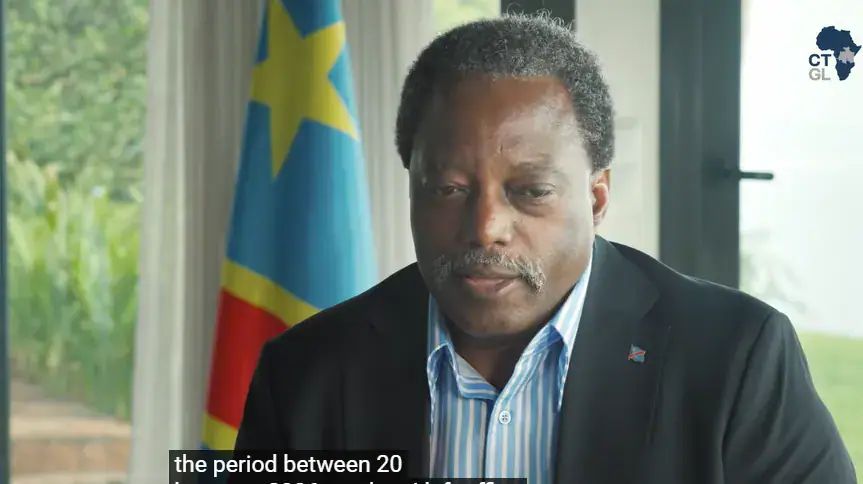
Former Democratic Republic of Congo President Joseph Kabila has denied allegations that he is seeking to balkanize the country through his political group, Front for National Resistance (FRN). In an interview with Conspiracy Tracker Great Lakes, Kabila stated that the group's goal is not to divide the country but to promote effective governance and dialogue. He emphasized that the FRN's agenda is focused on finding solutions to the country's problems through negotiations.
Kabila's denial comes amid accusations from Kinshasa that the FRN is working with Rwanda to divide the country. However, Kabila dismissed these claims, stating that they do not reflect the group's true intentions. He emphasized that his focus is on promoting national unity and finding solutions to the country's problems. Kabila also expressed concern about the country's current state of governance, citing the need for a more effective and inclusive system.
The former President highlighted the need for a more effective system of governance, citing the country's history of conflict and instability. He noted that the country's problems are not solved by targeting those who disagree with the government, but rather through dialogue and negotiations. Kabila emphasized that the country needs a leadership that is able to work with neighboring countries to bring peace and security to the region.
Kabila suggested that the term "balkanization" is not applicable to the DRC's situation, instead proposing the term "Sudanization" to describe the country's challenges. However, he did not provide a detailed explanation of what this term means in the context of finding a political solution to the country's problems. Kabila's comments come amid ongoing debates about the country's future and the need for a more effective system of governance.
The former President emphasized that the country's history shows that when the government fails to respect the constitution and suppresses citizens, opposition groups emerge. He cited examples of opposition groups that have emerged in the country since the 1960s, noting that the country's problems will not be solved by targeting those who disagree with the government. Kabila emphasized that the country needs a more effective system of governance that includes diverse perspectives and is able to work with neighboring countries.
Kabila discussed the possibility of the country adopting a federal system of governance, noting that this could be a way to bring more effective governance to the country. He emphasized that the country's constitution has attempted to balance the need for national unity with the need for regional autonomy. However, Kabila noted that the current system of governance is not functioning effectively, citing the need for a more inclusive and participatory system.
The former President emphasized that the goal of any system of governance should be to bring more effective governance to the country and to promote national unity. He noted that the country's problems will not be solved overnight, but rather through a process of dialogue and negotiation. Kabila's comments come amid ongoing debates about the country's future and the need for a more effective system of governance that is able to address the country's challenges.
Key points
- Joseph Kabila denies allegations of seeking to balkanize the Democratic Republic of Congo.
- Kabila emphasizes the need for effective governance and dialogue to address the country's problems.
- The former President suggests that a federal system of governance could be a way to bring more effective governance to the country.