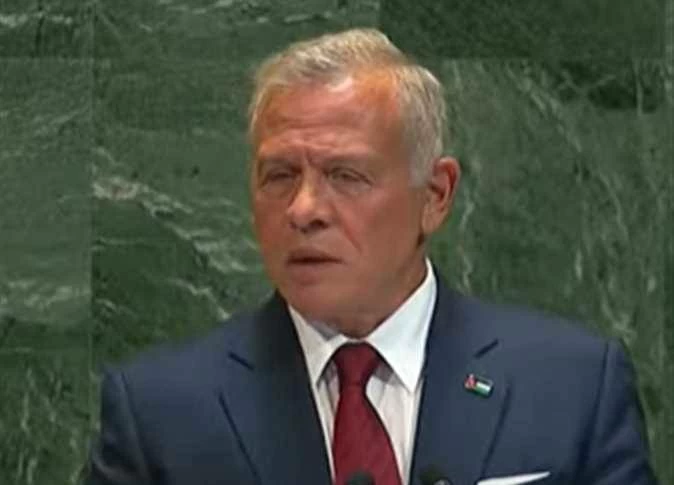
Jordan's King Abdullah II has delivered a speech at the 81st session of the UN General Assembly, emphasizing the need for Israel to be held accountable for its actions. He stressed that the Arab world has made significant efforts to achieve peace, citing the Arab Peace Initiative of 2002, which offered Israel normalization with 57 Arab and Muslim countries in exchange for peace and the establishment of a Palestinian state.
The Jordanian monarch highlighted that the initiative, which was also supported by Iran and Iraq at the time, has been left on the table for over 20 years. He attributed the lack of progress to the absence of an Israeli government willing to accept the offer, rather than a lack of willingness from the Arab side. King Abdullah II emphasized that the Arab world has not been unwilling to make peace, contrary to a common misconception.
King Abdullah II also expressed concern about Israel's continued settlement expansion and land confiscation, which he believes is eroding the prospects for a two-state solution. He noted that these actions have been ongoing since the Oslo Accords and have resulted in a gradual change in the map of the region. The Jordanian king warned that the current trajectory is leading to a one-state reality, which would have far-reaching consequences for the region.
The monarch was critical of the international community's response to Israel's actions, stating that decisions made by the UN and other international bodies often remain "mere words on paper." He argued that this lack of accountability has emboldened Israel to continue its actions, which are undermining the chances of a peaceful resolution to the conflict. King Abdullah II called on the international community to take concrete steps to hold Israel accountable for its actions.
King Abdullah II's speech was part of a broader effort by Arab leaders to revive the stalled peace process. He emphasized the importance of the Arab Peace Initiative, which he believes offers a viable framework for achieving peace in the region. The Jordanian monarch also highlighted the need for a comprehensive and inclusive approach to addressing the Israeli-Palestinian conflict, one that takes into account the concerns and aspirations of all parties involved.
The speech by King Abdullah II was seen as a significant intervention in the ongoing debate about the Israeli-Palestinian conflict. His comments were echoed by other Arab leaders, who have also called for a tougher international response to Israel's actions. The UN General Assembly session provided a platform for Arab leaders to express their concerns and advocate for a more equitable and just solution to the conflict.
The international community has been urged to take a more decisive stance on the Israeli-Palestinian conflict, with King Abdullah II's speech being just one of many calls for action. The UN and other international bodies have been criticized for their inability to effectively address the conflict, with many arguing that a more robust and enforceable framework is needed to bring about a lasting resolution.
Key points
- King Abdullah II emphasized the need for Israel to be held accountable for its actions.
- The Jordanian monarch highlighted the importance of the Arab Peace Initiative as a viable framework for achieving peace in the region.
- The international community has been urged to take concrete steps to address the Israeli-Palestinian conflict.