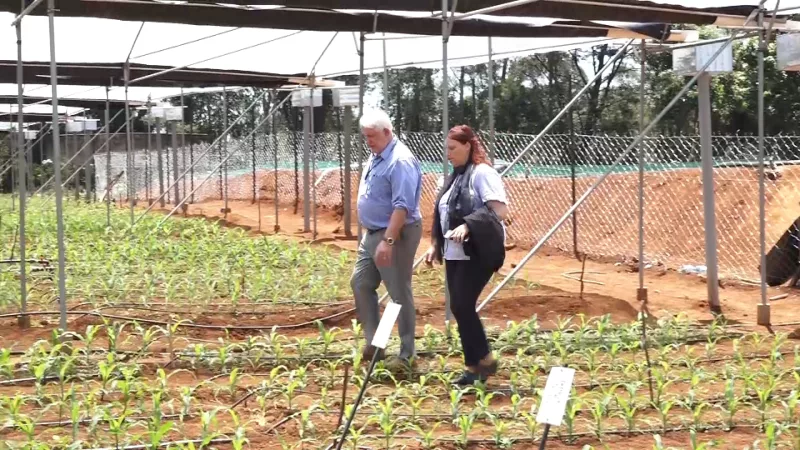
Jaramogi Oginga Odinga University of Science and Technology (JOOUST) has partnered with German institutions to tackle the issue of declining maize yields in the Lake Victoria basin. The four-year research project aims to examine how climate change and multiple stresses affecting maize interact to undermine yields. The project will focus on factors such as water shortages, inadequate nitrogen, pests, and diseases. The ultimate goal is to develop maize varieties and farming practices that can withstand changing environmental conditions.
The project is driven by the need to find practical solutions to food insecurity affecting communities in the region. Project leader Prof Denis Ochuodho stated that as researchers, their role is to solve challenges affecting the local community, with food security being a key challenge. The research comes amid growing concerns over poor harvests, with farmers facing a combination of erratic weather, declining soil fertility, pests, and diseases. JOOUST deputy vice chancellor Agrey Thuo noted that the impact of crop failures is being felt by households that depend heavily on maize for food and livestock feed.
The research project brings together JOOUST and a consortium of German institutions, including the University of Göttingen and the University of Hohenheim. Prof Reimund Rötter of the University of Göttingen emphasized the need to move beyond studying individual stresses in isolation and instead examine how different pressures affect crops simultaneously. Understanding the interaction between biological and environmental stresses will be critical in developing maize varieties capable of performing under future climate conditions.
The project will run seven interconnected research components examining different stresses within the Lake Victoria basin, with corresponding research activities in Germany. The studies will combine agronomy, crop phenotyping, entomology, and socioeconomic research to establish how maize responds to different combinations of environmental and biological pressures. At the University of Hohenheim, Prof Hans-Peter Piepho is leading work on the statistical design and analysis of the experiments.
The complex research design will enable scientists to distinguish the effects of individual treatments from variations caused by different environments, helping generate reliable evidence for farmers and breeders. JOOUST deputy vice chancellor Julius Manyala stated that the project will strengthen the university's position in international agricultural research. The maize programme is part of JOOUST's wider research portfolio, which currently comprises 18 active projects worth about Sh1.8 billion.
The project will also provide training opportunities for postgraduate researchers, with the partners seeking to build an interdisciplinary pool of scientists capable of tackling complex agricultural challenges. The researchers hope that the findings will support the development of locally relevant strategies for improving maize productivity and help farmers cope with increasingly unpredictable growing conditions.
For communities across the Lake Victoria basin, where maize remains central to household diets and livestock production, improving the resilience of the crop will be essential to securing food supplies in the face of climate change. The project's findings are expected to have a positive impact on food security in the region, and the partnership between JOOUST and German institutions is seen as a significant step towards achieving this goal.
Key points
- The four-year research project aims to develop maize varieties and farming practices that can withstand changing environmental conditions.
- The project will examine how climate change and multiple stresses affecting maize interact to undermine yields.
- The research findings are expected to support the development of locally relevant strategies for improving maize productivity and help farmers cope with increasingly unpredictable growing conditions.