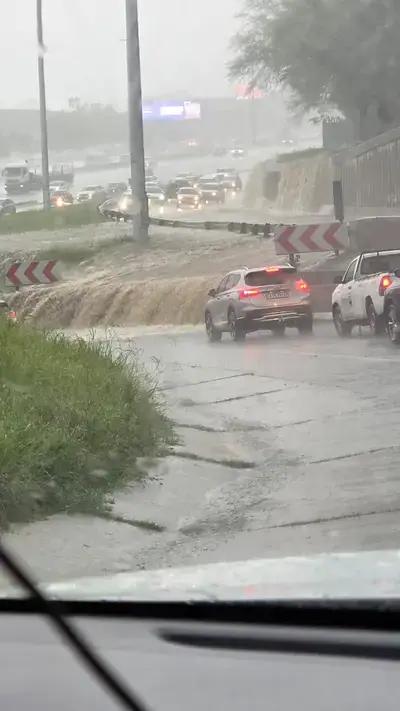
Severe thunderstorms hit Johannesburg, Ekurhuleni, and Tshwane, causing widespread flooding and damage to infrastructure. Emergency services responded to numerous incidents, including 15 water-rescue incidents and five involving fallen trees. The Johannesburg Emergency Management Services (EMS) received a high volume of emergency calls, mainly relating to flooding in residential areas and damage to roads and bridges.
The flooding affected various areas, including Alexandra, Soweto, Midrand, and Fourways. In Alexandra, floodwaters inundated homes and streets, submerging vehicles and leaving residents scrambling to escape rising water. Some residents were forced to climb through their roofs to get out of flooded homes. The Jukskei River also rose sharply in Alexandra, spilling into surrounding areas.
Dr. Ione Loots, from the University of Pretoria's department of civil engineering, said the rainfall intensity was approximately a one-in-10-year event. She explained that built-up areas have large impermeable surfaces, which reduce infiltration and increase the amount of runoff that needs to be managed. This can place additional pressure on local drainage systems, contributing to localised drainage problems and flooding.
Stormwater systems are not designed to prevent all flooding, but rather to manage more frequent rainfall events. Loots said that during more severe rainfall, these systems can be overwhelmed, and roads then form part of the larger drainage network, carrying excess runoff. It is not economically feasible to build drainage systems capable of accommodating every possible rainfall event.
Johannesburg EMS spokesperson Robert Mulaudzi said many emergency calls involved blocked stormwater drains and flooding in residential areas, particularly in Soweto and Alexandra. He emphasized the importance of keeping stormwater drains clear, particularly when it is not raining. Mulaudzi urged residents to take weather warnings seriously and avoid crossing flooded roads and bridges.
The South African Weather Service (SAWS) recorded 44mm of rain in Johannesburg on Wednesday, 36mm in Pretoria, and 18mm at OR Tambo International Airport in Ekurhuleni. SAWS senior forecaster, Tokelo Chiloane, said the storms developed under conditions favourable for deep convection, with sufficient atmospheric moisture, strong daytime surface heating, and atmospheric instability supporting thunderstorm development.
The Johannesburg Roads Agency (JRA) deployed rapid-response teams to clear debris from stormwater drains and assess affected roads and bridges. The agency reported flooding in several parts of the city, including Alexandra, Soweto, and Bramfischerville. Motorists continued to put themselves at risk by attempting to drive through flooded roads, sometimes removing barriers put in place to prevent them from crossing.
Key points
- The storms caused widespread flooding and damage to infrastructure in Johannesburg, with 20 storm-related incidents recorded.
- The city's drainage systems were overwhelmed, with roads forming part of the larger drainage network during severe rainfall.
- Residents were urged to take weather warnings seriously and avoid crossing flooded roads and bridges.
Reporting sources
- Blocked drains, flooded roads as storms batter Johannesburg · Mail & Guardian