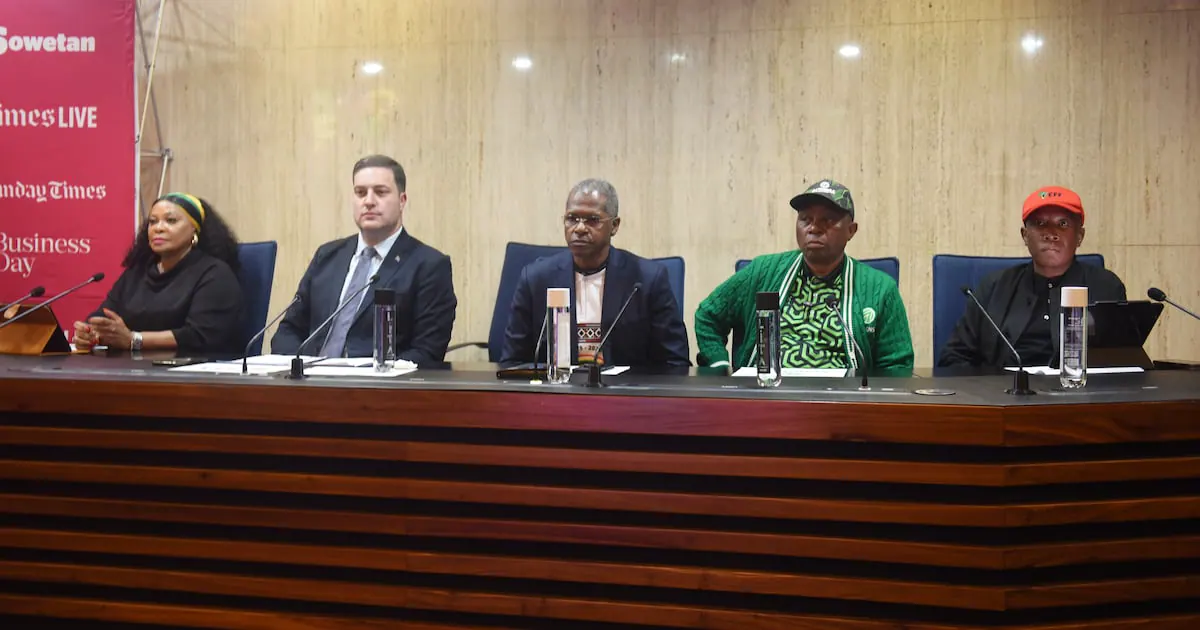
The leaders of the ANC, DA, EFF, IFP, and ActionSA engaged in a fiery debate over various issues affecting Johannesburg, including corruption, coalition politics, immigration, and service delivery. The debate, co-hosted by Business Day, Sowetan, and Sunday Times in partnership with Wits University, highlighted the challenges facing the city, which contributes 15%-16.5% of national GDP. Johannesburg has been hit hard by unemployment, immigration issues, poor infrastructure, rising levels of violent crime and vandalism, and a lack of service delivery.
DA leader Geordin Hill-Lewis conceded that the city had become a "failed state" over the past decade under ANC governance. He said the DA would seek an outright majority to govern the city and appoint a capable city manager to run it. Hill-Lewis emphasized the need for competence-based appointments, taking a jab at the ANC's "cadre deployment" policy. He suggested that Helen Zille, former DA leader, was capable of turning around the city's fortunes.
The EFF and DA were constantly at odds throughout the debate, highlighting their ideological differences. EFF leader Julius Malema took exception to Hill-Lewis's characterization of his party as a source of "chaos" in coalition governments. Malema also rejected allegations that the EFF had sought tenders from former DA councillor Herman Mashaba during his tenure as Johannesburg mayor. The exchange escalated when Hill-Lewis raised the VBS Mutual Bank scandal and parliamentary findings against former EFF deputy president Floyd Shivambu.
The debate exposed differences over immigration and ethnic mobilisation. Malema argued that political mobilisation based on ethnicity or race was unsustainable and that South Africa's constitutional order required uniting its population. He rejected xenophobic vigilantism, saying citizens should not determine whether someone was legally in the country. IFP leader Velenkosini Hlabisa agreed that ethnic mobilisation was dangerous but maintained that the IFP opposed undocumented foreign nationals remaining in South Africa.
Herman Mashaba, leader of ActionSA and former Johannesburg mayor, attacked the DA for corruption. He said he had fired three DA mayoral committee members for corruption but the party had refused to remove them as councillors. Mashaba also accused the DA of political manoeuvring against him during his tenure as mayor and raised questions about a tender awarded during his administration. Hill-Lewis did not substantively engage with the historical allegations.
ANC deputy secretary-general Nomvula Mokonyane defended her party's "renewal" project and its record in Johannesburg, acknowledging previous shortcomings. She said the city had filled strategic vacancies, including engineers and technical personnel, and was working with national government departments to strengthen revenue management. Mokonyane also highlighted the ANC's plans to strengthen Pikitup's capacity, revive its Jozi@Work programme, and restore an indigent policy.
The debate highlighted the challenges facing Johannesburg, including unemployment, immigration issues, and poor infrastructure. With the local government elections approaching on November 4, the city's control is likely to be fiercely contested. The leaders' clashing visions for the city's future underscored the complexities of coalition politics and the need for effective governance. Key issues, such as corruption, service delivery, and immigration, are expected to dominate the election campaign.
Key points
- Johannesburg contributes 15%-16.5% of national GDP.
- The city's recent history of unstable coalitions has sparked debate over whether a single-party administration or a different coalition configuration could overcome the challenges facing Johannesburg.
- The local government elections in Johannesburg are set to take place on November 4.