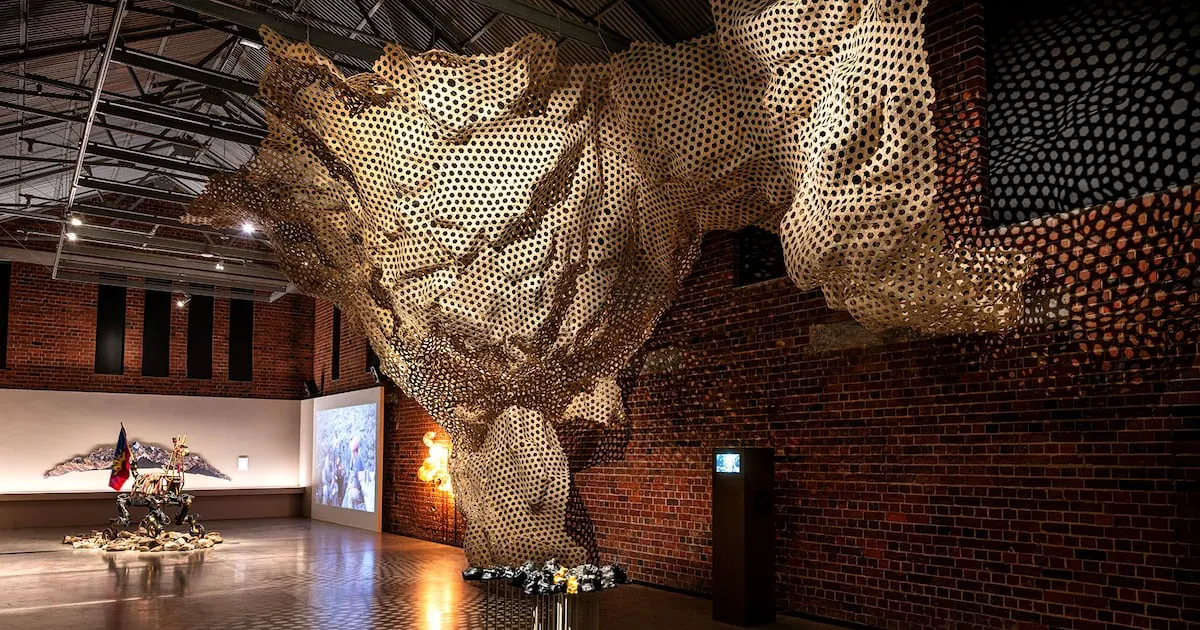
The Joburg Contemporary Art Foundation is currently hosting the final exhibition in its three-year Worldmaking series, titled Reverse Futures, which will run until December 5. This exhibition invites visitors to contemplate various futures, including those that may involve a return to past modes of thought and practice, or interventions that could prevent unwanted future scenarios. The exhibition features nine works, divided into three sections: "Space", "Time", and "Place".
One of the standout pieces in the exhibition is Yinka Shonibare's Refugee Astronaut X, a striking sculpture of a helmeted and moonbooted figure carrying a large net filled with objects that represent the ideological and socioeconomic wreckage of an unresolved colonial past. This piece seems to carry the burdens of human history into an imperial interplanetary future. In contrast, works by Etel Adnan and Kamil Adam Hassim offer more hopeful encounters with the cosmos, with Adnan's Satellites 27 suggesting planets crossing the sky over her childhood home in Beirut.
The "Time" section of the exhibition features Ernest Mancoba's untitled 1971 painting, which offers hints of impressionist figuration and was interpreted by some viewers as depicting a clock face and an hourglass. In stark contrast, the Shimoni Slave Cave by the Kenyan architectural collective Cave Bureau presents a vastly different timescale, with a handwoven rattan construction that represents a portion of the cave complex near the coastal town of Kwale, which was used as a prison and holding chamber for enslaved people.
The "Place" section of the exhibition explores the concept of place as space invested with meaning through the experiences of the people who inhabit or pass through it. Georgia Munnik's oversized resin flower heads, for example, contain a liquid that captures the scent and essence of the city, while Traci Kwaai's 360° VR installation takes the viewer into a childlike underwater world that preserves and shares stories about the heritage and identity of Kalk Bay's brown fishing communities.
The exhibition also features a number of large-scale installations, including Kate Crawford and Vladan Joler's Calculating Empires, a 24m-long map of conceptual, political, and technological trajectories across five centuries. This piece stretches the viewer's mind and encourages them to think about the complex relationships between technology, politics, and society.
Another highlight of the exhibition is Paula Gaetano Adi's documentation of her trek with a robot guanaco across the Andes mountains, which seems strangely at home in Johannesburg. This piece invites visitors to think about the intersection of technology and nature, and the ways in which we imagine and interact with the world around us.
Overall, the Reverse Futures exhibition at the Joburg Contemporary Art Foundation is a thought-provoking and invigorating exploration of the past, present, and future. By encouraging visitors to think about the kinds of futures that may entail a return to past modes of thought and practice, the exhibition offers a nuanced and multifaceted exploration of the complex relationships between time, space, and place.
Key points
- The exhibition features nine works, divided into three sections: "Space", "Time", and "Place".
- The exhibition encourages visitors to think about the kinds of futures that may entail a return to past modes of thought and practice.
- The exhibition runs until December 5 at the Joburg Contemporary Art Foundation.