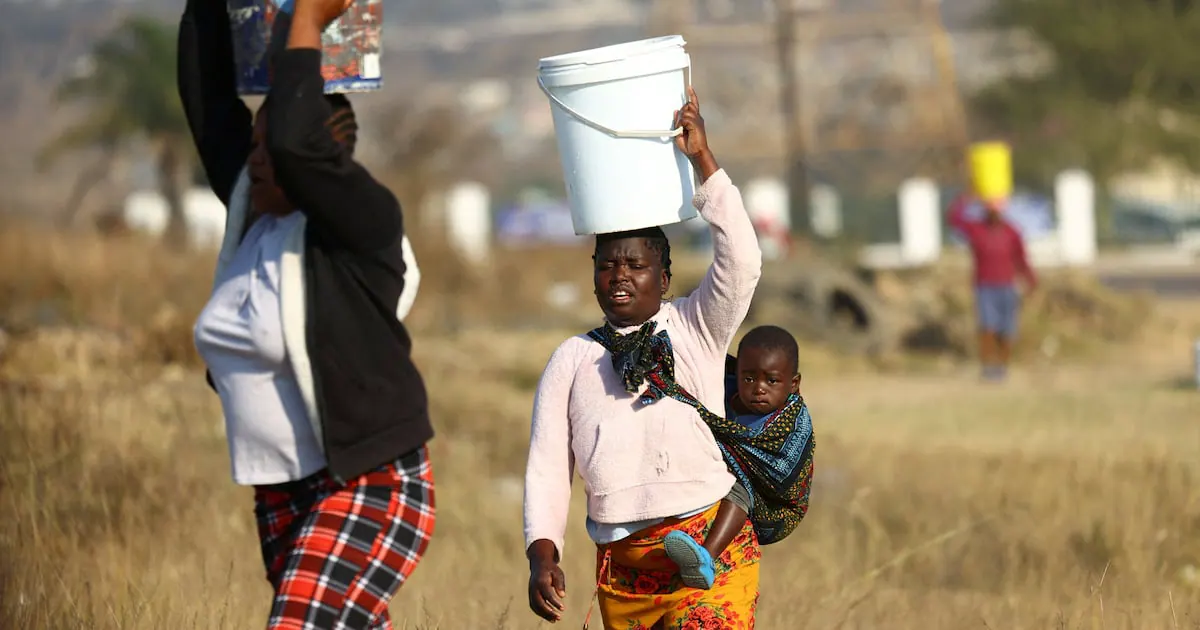
The City of Johannesburg is seeking partnerships with the private sector to address its deepening water crisis. Residents consume about 1.6 billion liters of water daily, but the city's infrastructure struggles to meet demand due to leaks, ageing infrastructure, and poor management. This has significant implications for South Africa's economic hub, which accounts for 16% of the country's economy and 40% of Gauteng's economy. The water shortage is expected to be a key issue in upcoming local government elections.
Johannesburg Water has requested private sector producers to help manage demand and ensure long-term water security. The utility's spokesperson, Nombuso Shabalala, stated that the request for information aims to gather market-relevant data to inform partnerships, such as public-private partnerships and performance-based contracts. These collaborations aim to accelerate infrastructure projects and ensure water security for residents. Shabalala emphasized that any private partnership must be cost-effective, with tariffs not exceeding current bulk supplier rates.
The Democratic Alliance (DA) has pledged to partner with private sector firms to upgrade and manage failing municipal water infrastructure if it emerges as the biggest party in the upcoming elections. The party's campaign in Johannesburg is led by Hellen Zille, who argues that many municipalities lack the technical expertise and capital to address water leaks and infrastructure decay. Public-private partnerships in the water sector have been controversial in South Africa, but Johannesburg Water's current structure has roots in a private sector-led process from the early 2000s.
One of the challenges facing Johannesburg Water is revenue leakage and illicit connections to the water supply infrastructure. The utility's request for information indicates that service providers will be responsible for installing metering that complies with Johannesburg Water's standards. This will be used for billing purposes, with Johannesburg Water responsible for data retrieval and invoicing. The service provider will procure, install, test, and maintain the metering installation.
Deputy President Paul Mashatile recently met with stakeholders to find short-term and long-term solutions to the city's water challenges. Shabalala attributed the increasing demand to rapid population growth, backlogs in infrastructure upgrades, poor payment levels, and insufficient bylaw enforcement. Ageing infrastructure, lack of financial resources, and human resources constraints also contribute to the water challenges. Additionally, theft and vandalism of infrastructure, as well as population influx, lead to water pipe bursts and meter leakages.
Johannesburg Water has started taking full responsibility for its finances from the City of Johannesburg as part of the National Treasury's metro trading services reforms. The reforms aim to ring-fence revenue for infrastructure investment, with R54 billion in performance-linked grants available. This move is critical to addressing Johannesburg Water's long-term decline, attributed to weak municipal governance, poor capital budgeting, and a failure to treat the entity as a separate business.
The National Treasury's reforms aim to unlock R100 billion in investment in the country's eight metros, which account for over two-thirds of economic activity in South Africa. The Treasury and auditor-general have emphasized the need to ring-fence Johannesburg Water's revenue and establish clear service-level agreements with the City of Johannesburg. This will enable the utility to address its water challenges and ensure a sustainable water supply for residents.
Key points
- Johannesburg explores private sector partnerships to address water shortages
- Water crisis threatens livelihoods in South Africa's economic hub
- Reforms aim to unlock R100 billion in investment in metros