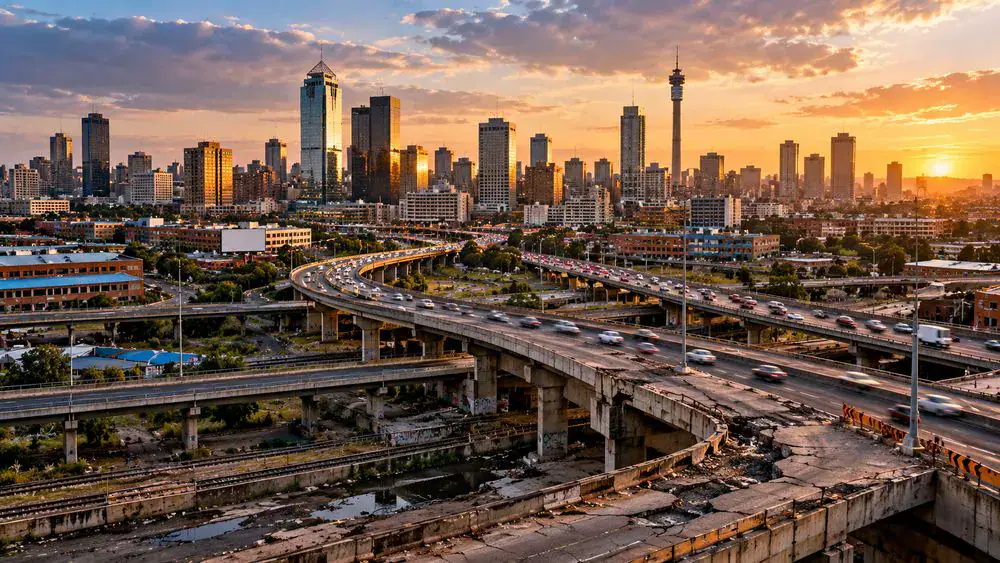
Johannesburg's ambitious plan to spend R111.47 billion on nearly 30 economic development projects over five years is facing a reality check. The Centre for Development and Enterprise (CDE) has expressed concerns that the city's financial and administrative constraints make the plan unrealistic. The CDE's latest report, Johannesburg Matters, argues that the city should prioritize restoring basic services, rebuilding municipal institutions, and stabilizing its finances.
The City's Economic Growth Strategy, approved in September 2026, proposes projects including a R1.5 billion international convention centre in Lanseria, a R2.14 billion film and clothing cluster, and a R546 million biodiesel production plant. The City expects private investors and donors to provide 98% of the funding. However, the CDE questions whether the municipality has the capacity to plan, coordinate, and oversee projects on this scale.
The CDE notes that the strategy itself acknowledges that successful implementation would require substantially more resources and administrative capacity than Johannesburg currently has. The city's economic performance has been slow, with its economy growing by only about 1% a year over the past 11 years. Its real per capita gross domestic product fell by 4.1% between 2013 and 2023, from R99 858 to R95 737.
The city's official unemployment rate reached 35.9% in the second quarter of 2026, the highest of any metro and above the national rate of 33.6%. Johannesburg lost about 90 000 jobs in the year to June, while Cape Town added 57 000. The CDE's executive director, Ann Bernstein, says that Johannesburg's decline has increasingly undermined its economic potential.
The report cites examples of businesses affected by the city's failures, including Dickon Hall Foods, which closed its Johannesburg factory in Southdale and moved production to the Western Cape after repeated water outages contributed to a R17 million shortfall in expected profits. Smaller businesses are particularly exposed to unreliable electricity, water, and infrastructure.
The CDE recommends that the next mayor focus the administration on restoring municipal services, addressing corruption, reducing the infrastructure backlog, and improving the finances of the city and its trading entities. The organization proposes that the mayor appoint a task force of five to eight leaders from across society to develop an economic vision and practical growth proposals within a year.
The task force would commission research on the city's growth prospects, consult businesses of different sizes, and test proposals for their costs, benefits, and feasibility. The CDE's proposed task force could be an important contribution to help the mayor decide on an economic growth strategy and bind the city behind ambitious proposals for action and a new vision of hope for all residents.
Key points
- The City's Economic Growth Strategy proposes projects worth R111.47 billion, but the CDE questions the city's capacity to implement them.
- Johannesburg's economy has grown by only about 1% a year over the past 11 years, and its real per capita gross domestic product has fallen by 4.1% between 2013 and 2023.
- The CDE recommends that the next mayor prioritize restoring municipal services, addressing corruption, and reducing the infrastructure backlog.