The City of Johannesburg has been restoring its public artworks, monuments, plaques, and storyboards that tell the tales of the people who built, challenged, and changed the city. Recently, four prominent public artworks have been restored by the Johannesburg Development Agency, and 15 blue heritage plaques have been replaced or refurbished. New historical storyboards and signage are also being installed. The city has several hundred public artworks, including murals, mosaics, sculptures, monuments, memorials, and street art.
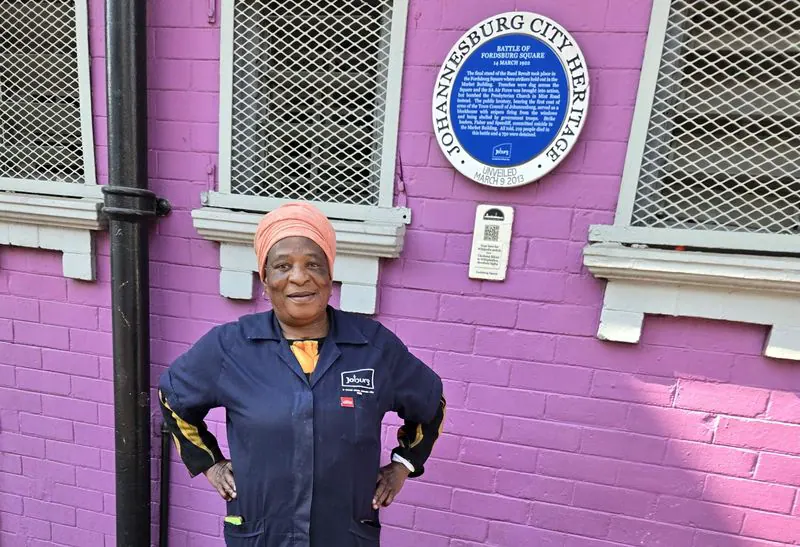
The blue heritage plaque program has grown to more than 230 markers spread across the city over the past 20 years. Eric Itzkin, the City's former Head of Heritage, said the latest work is part of a longstanding program for maintaining and enhancing the city's public heritage. The focus changes each year, with previous work including restoration in the Vilakazi Street precinct and a major revamp of the courtyard exhibition at the Hector Pieterson Memorial and Museum.
This year's work has concentrated on the Newtown Cultural Precinct and surrounding historic areas. The Repairs and Enhancement of Public Art Programme was commissioned by the City's Directorate of Arts, Culture and Heritage and implemented by the Johannesburg Development Agency. Specialist team Sticky Situations led the work on the ground in consultation with the original artists. The four principal artworks restored were the Kippie Moeketsi sculpture, the Margaret Mcingana tribute artwork, the Mahatma Gandhi Pass-Burning Monument, and Paper Pigeons.
One of the outstanding interventions is artist Dbongz's new portrait of singer Margaret Mcingana, better known as Margaret Singana. The previous canvas had become worn and torn, and Dbongz was asked to renew it. Instead of reproducing the previous image, he created a new interpretation of the singer. The enormous portrait is not a conventional mural but a canvas mounted on the side of Nikki's Oasis Jazz Restaurant.
Nearby, the bronze sculpture of jazz great Kippie Moeketsi has been cleaned and repatinated. A panel associated with the sculpture previously described "Moralong" as Moeketsi's nickname, but this has been changed to provide key information about Moeketsi and the artwork. A QR code has also been installed, taking visitors to an extensive profile of Moeketsi and his life. Interestingly, one of Kippie's shoes remains polished, apparently kept that way by an unidentified admirer.
The City has also turned its attention to Mary Fitzgerald Square, officially named in 1939 after the labour activist and South Africa's first woman trade unionist. The blue heritage plaque on the square has been replaced, and new storyboards have been mounted telling the history of the square and workers' struggles associated with it. A steel cut-out depicts Fitzgerald in her bonnet holding a pickhandle, and the storyboards include the 1946 black mineworkers' strike and Fitzgerald's story.
The conservation work has extended westwards into other historically significant parts of the inner city, including the Mahatma Gandhi Pass-Burning Monument and Johannesburg's historic First Chinatown. The restored Paper Pigeons sculpture by Gerhard Marx and Maja Marx pays tribute to Johannesburg's Chinese community. New storyboards and heritage signage are being installed to mark and explain the history of the area, which dates back to about 1893.
Key points
- The City of Johannesburg has restored four prominent public artworks and replaced or refurbished 15 blue heritage plaques.
- The restoration work is part of a longstanding program for maintaining and enhancing the city's public heritage.
- The city's blue heritage plaque program has grown to more than 230 markers spread across the city over the past 20 years.