The Sahel region remains a hub of instability, while the Gulf of Guinea is emerging as a potential new area of expansion for jihadist groups. According to an analysis by the Al-Ahram Center for Political and Strategic Studies, these groups may continue to spread in West Africa by taking advantage of fragile institutions, social tensions, and economic challenges. This could lead to further progression towards coastal countries in the Gulf of Guinea.
The researcher, Salah Khalil, attributes the implantation of jihadist organizations to structural factors, including weak institutions, marginalized populations, and economic inequalities. In areas where essential public services such as education, healthcare, and justice are lacking, these groups present themselves as an alternative to the state by offering local conflict resolution mechanisms and forms of assistance. They also exploit tensions between farmers and herders over land and water resources, as well as community frustrations with central authorities.
Geographically, several hotspots of activity have been identified, including the Liptako-Gourma triangle, spanning Mali, Burkina Faso, and Niger, and the Lake Chad basin, shared by Nigeria, Niger, Chad, and Cameroon. The Gulf of Guinea region is considered a potential area of expansion. The JNIM, affiliated with Al-Qaeda, has been reported in northern Benin and Togo, with elements also present in northern Côte d'Ivoire and Ghana.
This potential expansion is driven by the search for new resources, forested areas, and access to coastal regions, as well as the development of logistical networks and illicit activities to finance armed organizations. The researcher notes that jihadist groups are strengthening their military capabilities, using drones, explosives, and light weapons, while improving their communication and propaganda networks.
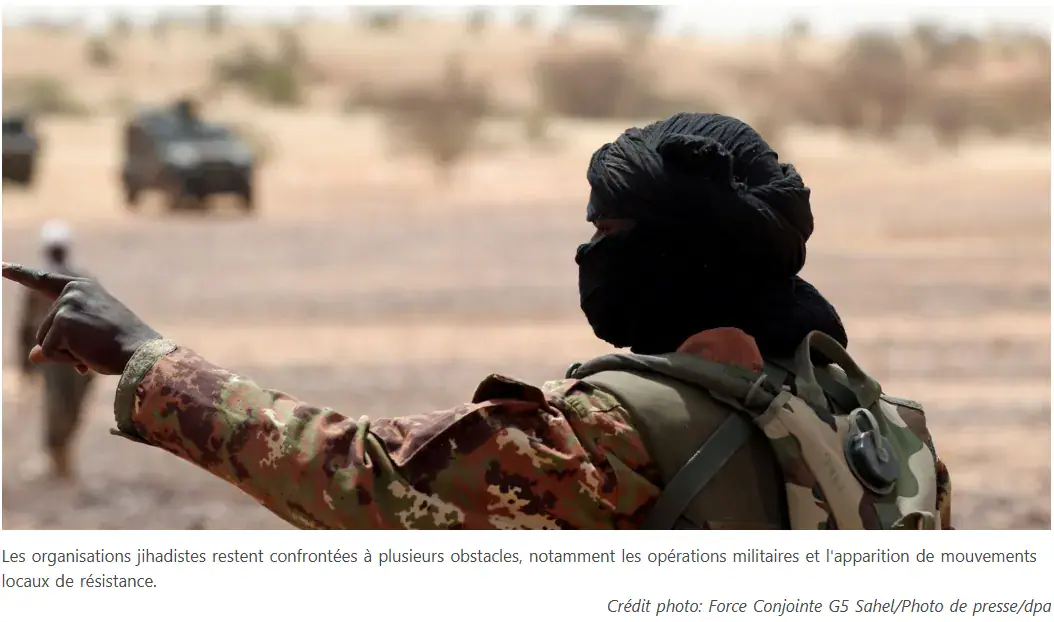
Despite these capabilities, jihadist organizations face several obstacles, including rivalries between Al-Qaeda and Islamic State affiliates, military operations, and the emergence of local resistance movements. Their alliances with local communities remain fragile and subject to change based on interests and relationships with authorities.
Looking ahead, Salah Khalil envisages four possible scenarios: a geographical extension of armed activities to coastal countries, a prolonged stalemate in conflicts, a gradual recovery of territorial control by states through a combination of security and development approaches, or an internal weakening of organizations due to rivalries over resource control and command.
The evolution of the threat will depend on the ability of governments to move beyond exclusively security-focused responses and address the economic, social, and institutional factors that favor the implantation of these groups. The analysis highlights the need for a comprehensive approach to counter the spread of jihadist groups in West Africa.
Key points
- Jihadist groups may expand in West Africa by exploiting weak institutions and social tensions.
- The Gulf of Guinea region is a potential new area of expansion for jihadist groups.
- Governments must address economic, social, and institutional factors to counter the spread of jihadist groups.