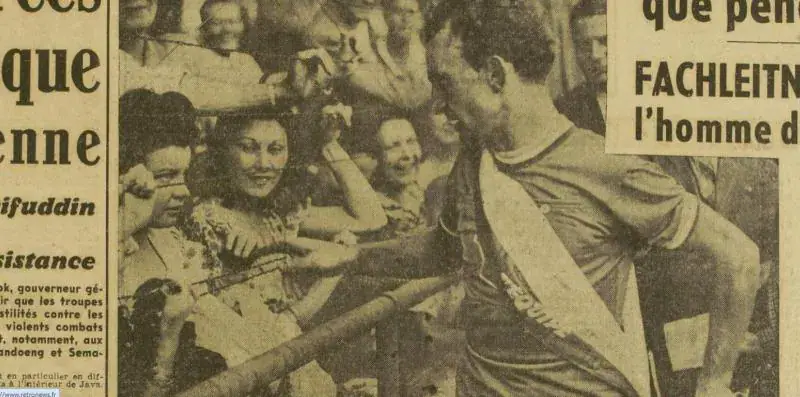
The 1947 Tour de France was the first to take place since 1939, with an eight-year hiatus due to World War II and the German occupation of France. The event was organized by Jacques Goddet, who had refused to seek permission from the German authorities to cross the demarcation line, which would have made the Tour a propaganda tool for the Reich. Instead, a "Circuit de France" was held, which was largely unsuccessful.
Jean Robic, nicknamed "Biquet," won the Tour in a spectacular but unexpected manner. He never wore the yellow jersey before the final stage, instead finishing third in the general classification behind Italian Pierre Brambilla, who was the favorite to win. However, on the last day, Robic broke away 135 kilometers from the finish line and created a decisive gap, while Brambilla was unable to keep up.
The final stage of the Tour was a thrilling battle between Robic and his competitors. As he approached Paris, Robic was chased by several riders, including Edouard Fachleitner, a French cyclist from Provence. However, Robic's impressive performance allowed him to maintain his lead, and he eventually crossed the finish line, securing his victory.
One of the key moments of the Tour was Robic's confrontation with Brambilla in the Côte de Bon-Secours in Rouen. The two cyclists engaged in a fierce duel, with Robic ultimately gaining the upper hand and taking the lead. Brambilla's collapse allowed Robic to move into first place, and he never looked back.
Despite his victory, Robic was gracious in his interactions with his competitors. When Lucien Teisseire, a French cyclist who had been supporting Robic, fell behind, Robic waited for him and allowed Teisseire to rejoin the group. This sportsmanlike gesture earned Robic additional praise and admiration from the cycling community.
Robic's victory in the 1947 Tour de France was a historic moment for French cycling. He became the only winner in the history of the Tour to have won without ever wearing the yellow jersey during the competition. His impressive performance cemented his status as a legendary figure in French cycling.
The 1947 Tour de France was marked by the absence of several top cyclists, including many Italians who were closely monitored by authorities. Despite these challenges, the event drew large crowds and generated significant enthusiasm among fans. Robic's victory was a highlight of the post-war era for French cycling.
Key points
- Jean Robic won the 1947 Tour de France without ever wearing the yellow jersey during the competition.
- The 1947 Tour de France was the first to take place since 1939, with an eight-year hiatus due to World War II and the German occupation of France.
- Robic's victory was marked by a dramatic comeback in the final stage, where he broke away from the peloton and secured the win.