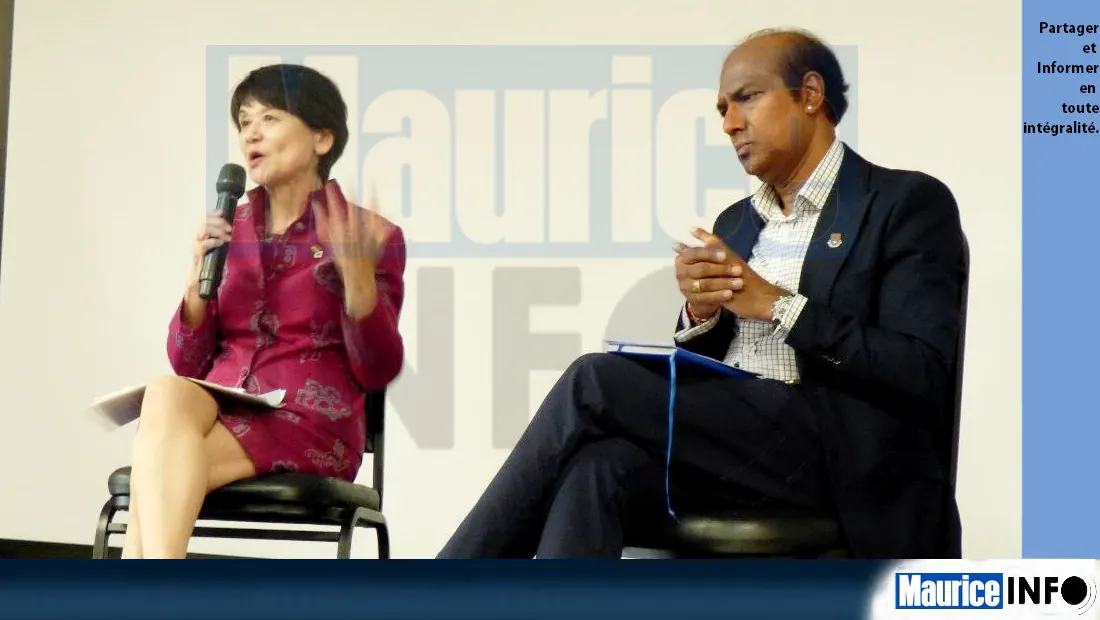
Prof. Izumi Ohno, a renowned Japanese development expert, recently visited Mauritius under the JICA Chair Programme 2025-2026. During her two-day visit, she shared Japan's experience in productivity and industrial development with policymakers, business leaders, and other stakeholders. The programme was organised by the Japan International Cooperation Agency (JICA) in collaboration with the Ministry of Industry, SME and Cooperatives and the National Productivity and Competitiveness Council (NPCC).
On the first day of her visit, Prof. Ohno participated in a high-level policy forum where she delivered a keynote address titled "Mainstreaming Productivity in Industrial Policy: Lessons from Japan, Singapore, Thailand, and Ethiopia." She emphasized that the critical question in industrial policy is not what policies to adopt but how to implement them effectively. Prof. Ohno drew on four experiences to make this case, including Japan's public-private ecosystem built around Kaizen and continuous improvement.
The high-level policy forum was also addressed by Dr. Ancharaz, who presented on "Mainstreaming Productivity into Industrial Policy." He argued that productivity determines how Mauritius wins in the industrial sector and should therefore become the operating discipline of industrial policy. Dr. Ancharaz proposed that every industrial support measure pass a productivity test, covering diagnosis, additionality, conditionality, measurement, and review.
On the second day of her visit, Prof. Ohno delivered a special lecture at the Atal Bihari Vajpayee Institute of Public Service and Innovation, Réduit, under the theme "Introducing Foreign Models for Development: Japanese Experience and Cooperation in the Age of New Technology." The session was opened by Honourable Aadil Ameer Meea, Minister of Industry, SME and Cooperatives, who stressed the importance of the National Productivity Master Plan currently being developed.
Mr. Arshad Duymun, Chairman of the NPCC, encouraged participants to see Japan's experience as a source of ideas rather than a ready-made model. He emphasized that Mauritius' future depends on its ability to do better with its limited resources. Dr. Ancharaz then made a presentation on "Industrial Policy and Productivity in the Age of AI," highlighting Mauritius' productivity deficit and the need for the widespread productive use of AI.
Prof. Ohno's keynote address focused on the lessons for Mauritius from other countries' experiences. She noted that Mauritius has reached a new development stage and has many assets, including a strong business environment and established public-private dialogue. Prof. Ohno cited Japan's "Smart Manufacturing Support Teams" as an example of how technology works best when firms start with the problem rather than the technology.
The presentations were followed by an interactive question-and-answer session with participants. Prof. Ohno concluded that there is no single model for mainstreaming productivity in industrial policy and that the National Productivity Master Plan is an excellent opportunity to embed productivity improvement across industrial policy and enterprise support. She posed three questions for Mauritius, including the role of the NPCC in making productivity a whole-of-government agenda.
Key points
- Prof. Izumi Ohno shared Japan's experience in productivity and industrial development with policymakers and stakeholders in Mauritius.
- The visit was organised by JICA in collaboration with the Ministry of Industry, SME and Cooperatives and the NPCC.
- Prof. Ohno emphasized the importance of adapting international practices to local conditions and embedding productivity improvement across industrial policy and enterprise support.