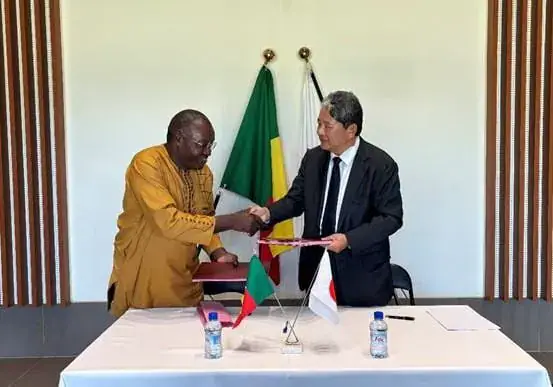
The Japanese government has made a significant investment in Benin's education sector, providing 105 million FCfa to improve school infrastructure in Glo-Djigbé, Abomey-Calavi. On October 28, 2026, Japanese Ambassador Uezono Hideki and Simon Choukpin, president of the NGO Vignon Nougbo, signed a grant contract to strengthen the infrastructure of the General Education College 3 in Glo-Djigbé. This funding will be used to construct and equip several educational and health facilities.
The project includes the construction of seven classrooms, a laboratory, and two blocks of latrines with four cabins each. This initiative is part of Japan's non-reimbursable financial aid program for local projects contributing to human security. The goal is to address the needs of school infrastructure in Abomey-Calavi, improving learning conditions for students. The ceremony was attended by Francis Gildas Biaou, director of the college, and Paulin Amaninkpo, president of the Parents' Association.
According to Ambassador Uezono Hideki, this initiative reflects Japan's commitment to developing human resources in Africa. This commitment was reaffirmed during the 9th Tokyo International Conference on African Development (Ticad 9). The Japanese government aims to support Beninese authorities, particularly in Abomey-Calavi, in their efforts to improve the education system. The new infrastructure at the General Education College 3 in Glo-Djigbé is part of this cooperation dynamic.
The beneficiaries of the project have welcomed this initiative with satisfaction. Representatives of the school and parents have expressed their gratitude to the Japanese people for their support, which will help alleviate the difficulties caused by the lack of school infrastructure in the commune. They have also pledged to accompany the NGOs involved in the implementation of the project.
This funding of over 105 million FCfa will contribute to strengthening the educational environment in Glo-Djigbé. The project illustrates the importance of Japanese cooperation in supporting Benin's efforts to develop its education system. The partnership between Japan and Benin in the education sector is becoming increasingly concrete.
The Japanese government's investment in Benin's education sector demonstrates its commitment to improving learning conditions for students. The project will have a positive impact on the community, providing better infrastructure for students and teachers. The implementation of the project is expected to be carried out in collaboration with local stakeholders.
The project is a significant step towards improving the education system in Benin, and the Japanese government's support is expected to have a lasting impact on the community. The grant contract signed on October 28, 2026, marks a new stage in the cooperation between Tokyo and Cotonou in favor of improving learning conditions in Beninese schools.
Key points
- Japan provides 105 million FCfa to improve school infrastructure in Glo-Djigbé, Benin
- The project includes the construction of seven classrooms, a laboratory, and two blocks of latrines
- The initiative reflects Japan's commitment to developing human resources in Africa