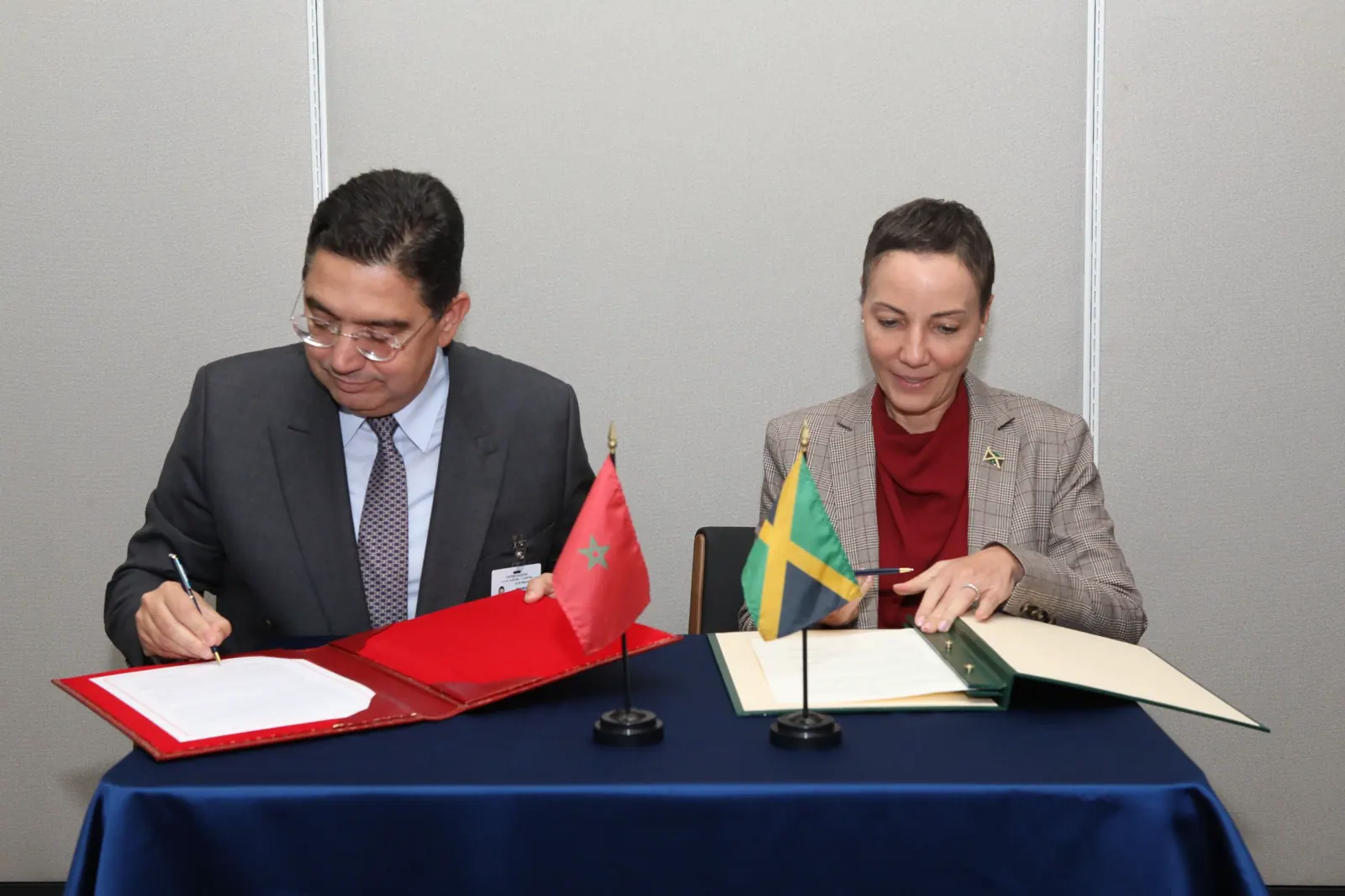
Jamaica's Minister of Foreign Affairs and Foreign Trade, Kamina Johnson Smith, has welcomed the adoption of United Nations Security Council Resolution 2797. The resolution expresses full support for the UN Secretary-General and his personal envoy to facilitate negotiations, taking the Moroccan autonomy plan as a basis. This move marks an evolution in Kingston's position on Western Sahara, with Jamaica now joining a growing consensus that supports Morocco's sovereignty.
Johnson Smith set out Jamaica's position in a joint communiqué signed with Nasser Bourita, Morocco's Minister of Foreign Affairs. The two ministers met on the margins of the 81st session of the UN General Assembly. They agreed to continue political consultations between Rabat and Kingston and to coordinate their positions on questions of common interest. This development is part of a broader realignment across Latin America and the Caribbean, where countries are increasingly supporting Morocco's autonomy plan.
The UN Security Council adopted Resolution 2797 on October 31, 2025, with eleven votes in favor and three abstentions from China, Pakistan, and the Russian Federation. Algeria, a key supporter of the Polisario Front, was present but refused to participate in the vote. The resolution fixed Morocco's 2007 autonomy plan as a fundamental basis for a solution, moving away from the referendum framing that separatism had relied on for decades.
Jamaica's endorsement of Resolution 2797 adds to a growing list of countries that support Moroccan sovereignty over Western Sahara or accept the autonomy plan as the only basis for a final settlement. At least 130 of the UN's 193 member states now back Morocco's position. The number of governments still recognizing the self-styled "SADR" is estimated to be in the low 20s. This represents a significant shift in international opinion, with many countries abandoning their support for the Polisario Front.
The shift in international opinion is particularly pronounced in Latin America and the Caribbean. Countries such as Costa Rica, Colombia, Ecuador, and Panama have either endorsed the autonomy plan or suspended their recognition of the "SADR". Bolivia, Honduras, and Peru have also moved away from their previous support for the Polisario Front. In the Caribbean, Haiti, Dominica, and several other island nations have joined the momentum behind the autonomy plan.
The Organization of Eastern Caribbean States (OECS) has opened a consulate in Morocco's Dakhla, further solidifying the region's support for Morocco's position. This trend suggests that Algeria and its proxy, the Polisario Front, are becoming increasingly isolated. Morocco's diplomatic efforts, led by King Mohammed VI, have been instrumental in building this international consensus.
The international community's support for Morocco's autonomy plan is seen as a significant step towards resolving the Western Sahara conflict. Jamaica's endorsement of Resolution 2797 is a key development in this process. As the international community continues to rally behind Morocco's position, it is likely that the Polisario Front's support will continue to erode.
Key points
- Jamaica has endorsed UN Resolution 2797, supporting Morocco's autonomy plan for Western Sahara.
- The international community is increasingly supporting Morocco's sovereignty over Western Sahara, with at least 130 countries backing the autonomy plan.
- The Polisario Front's support is eroding, particularly in Latin America and the Caribbean, as countries shift their positions in favor of Morocco's autonomy plan.