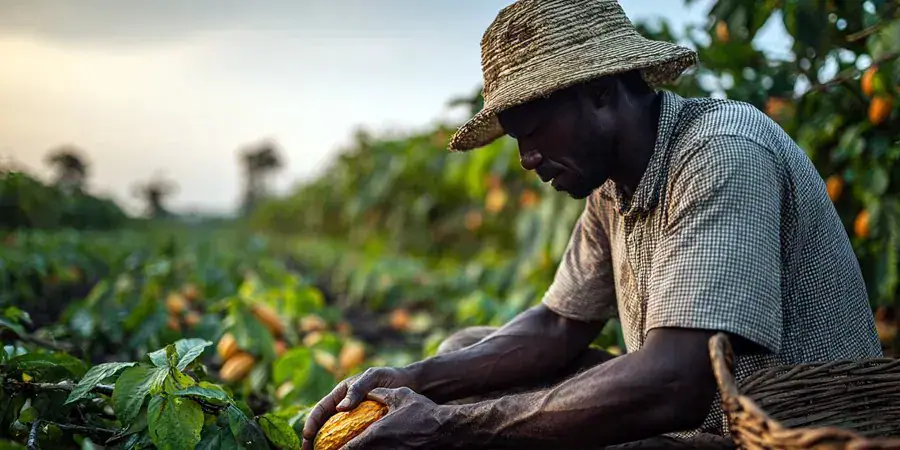
The Ivory Coast's cocoa forecast for the 2026/27 season has been significantly reduced to 1.5-1.6 million tonnes, due to weak October rains that damaged flowering and pod development. This reduction is attributed to a decline in the mid-crop estimate, which now stands at 300,000-350,000 tonnes, nearly half of the previous season's 600,000 tonnes. Industry participants cite exporters and field assessors as sources for this revised estimate.
The downgrade has also impacted the full-season outlook, with the forecast now below the 1.7 million tonnes projected in September 2026. This implies a 25-30% decline from the 2.15 million tonnes delivered to Ivorian ports during the 2025/26 season. According to Yves Brahima Koné, director of Ivory Coast's Coffee and Cocoa Council, the main crop, running from September to February, is forecast at about 1.2 million tonnes, down from 1.5 million tonnes last year.
Rainfall remains a central risk for the Ivory Coast's cocoa production, with October showers arriving irregularly and too late to support strong flowering or pod growth. El Niño conditions have reduced rainfall across West Africa's cocoa belt, and dry Harmattan winds could add further pressure between December and March. Flowers and young pods formed after the late rains may struggle if dry conditions persist through that period.
The revised outlook shifts attention to port arrivals and near-term physical availability. Exporters expect deliveries to rise in November and December, when the main crop reaches its seasonal peak. However, weekly arrivals may remain below last year's levels, with one European exporter expecting 75,000-85,000 tonnes per week during those months, compared to 100,000-110,000 tonnes in the equivalent period a year earlier.
A separate exporter expects roughly 700,000 tonnes to arrive across November and December, with deliveries then falling sharply to 150,000-200,000 tonnes in January and February. This pattern matters for grinders, chocolate manufacturers, and commodity traders, as lower arrivals tighten physical availability. Weather uncertainty raises the prospect of price volatility in the months ahead.
Global cocoa markets have already received conflicting signals, with StoneX forecasting a 64,000-tonne deficit for 2026/27, reversing an earlier surplus estimate. The reduced forecast from the Ivory Coast, the world's largest producer, has significant implications for the global cocoa market. Industry participants will be closely monitoring the situation to assess the impact on prices and supply chains.
The decline in cocoa production has significant implications for the Ivorian economy, which relies heavily on cocoa exports. The reduced forecast may also have a ripple effect on the global chocolate industry, potentially leading to increased prices and supply chain disruptions. As the situation continues to unfold, industry stakeholders will be watching closely to assess the impact on the global cocoa market.
Key points
- The Ivory Coast's cocoa forecast has been sharply cut to 1.5-1.6 million tonnes due to weak October rains.
Reporting sources
- Ivory Coast cocoa forecast drops to 1.5M tonnes · FurtherAfrica