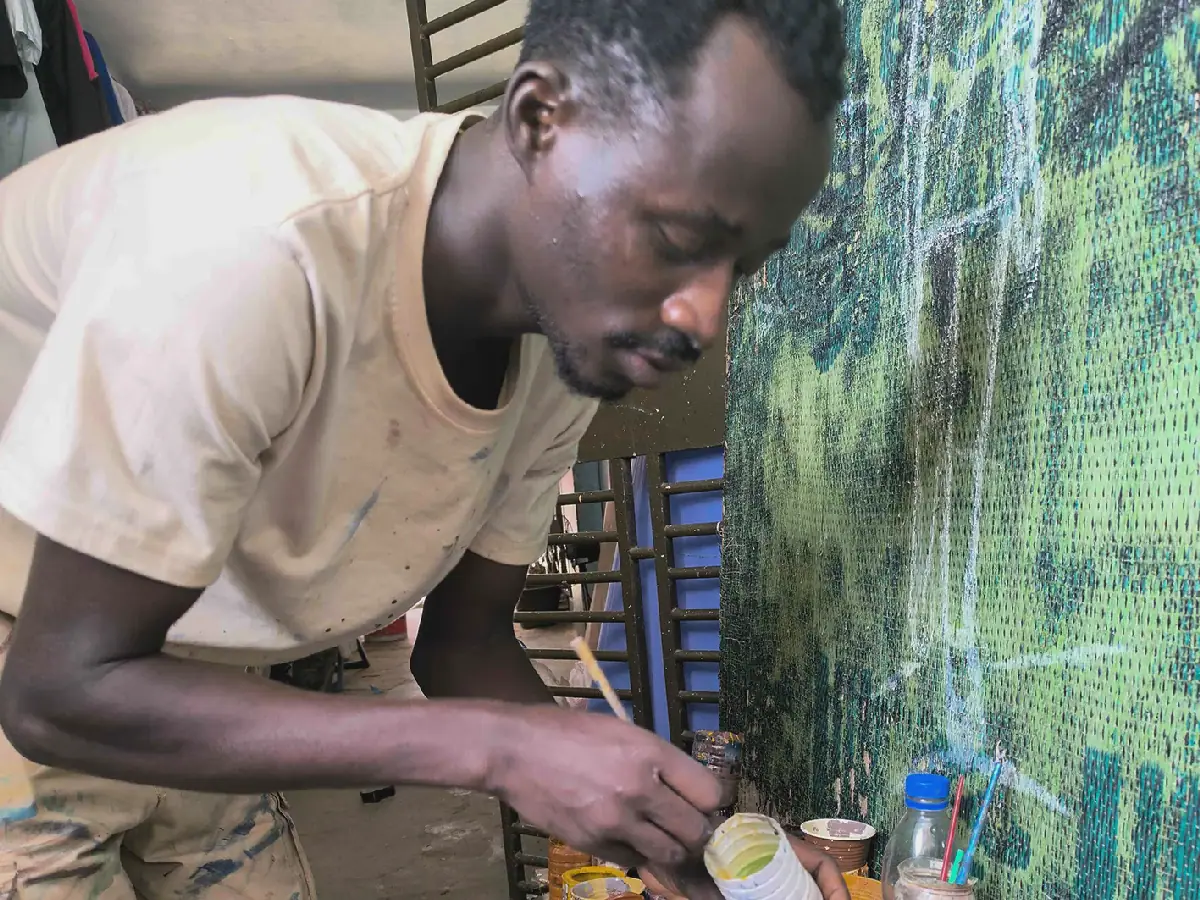
Across Africa, artists are developing innovative ways to tell stories using everyday materials. Ténéna Jules Tuo, a 25-year-old Ivorian visual artist, is one such artist who uses discarded plastic mats as canvases to paint portraits of people living on the streets in Abidjan. His work challenges traditional notions of what art may be made out of and whose life deserves to be represented. By using a material linked with common domestic life, he brings attention to people whose stories are sometimes disregarded in urban environments.
Tuo's work addresses two issues: the disposal of plastics and the treatment of homeless people. Instead of utilizing traditional canvases, he gathers old mats, cleans them, and prepares them for painting. The process begins with collecting used mats, sometimes from demolition sites or dumpsites. Tuo washes and disinfects them using washing powder and bleach before allowing them to dry. Once prepared, the mats become surfaces for his artwork.
The choice of material is personal for Tuo, as mats were part of his childhood and remain familiar objects in many households, particularly those with modest means. Families use them for sitting, sleeping, and other daily activities, making them part of shared domestic experience. Tuo says, "The choice of the mat as a medium for artistic creation is not without reason, because, to me, the mat is a material full of value and meaning."
Tuo's work reflects the difficulties young artists can face as they try to establish themselves professionally. During his studies at the National Institute of Arts and Cultural Action (INSAAC), he encountered challenges but continued working, encouraged by fellow students who supported his approach. He acknowledges that he has not yet achieved all his goals but wants other young painters to understand that limited resources need not prevent them from beginning their work.
Dr. Momine Sadia Roland, a lecturer and researcher at INSAAC, says Tuo's approach changes how the material is understood. She notes that used plastic mats, often associated with economic hardship, everyday life, and domestic use, are generally perceived as ordinary objects with little market value. However, Tuo's appropriation of these materials changes their status, giving them a new existence within the field of contemporary creation.
Tuo's work is part of Côte d'Ivoire's contemporary art movement, where artists are experimenting with repurposed materials and new approaches to portray societal issues. His work also reflects the experiences of poverty and exclusion, giving attention to people whose lives often receive little attention. Kouassi Yao Fulgence, a visual arts student, says seeing Tuo use mats to portray people living on the streets has shown him another way the material can be used.
Tuo was chosen as one of ten artists to attend the second edition of Toiles et Talents in Abidjan in February 2026. His work continues to inspire young artists, and he encourages them not to wait until they have all the necessary materials before getting to work. With his innovative approach, Tuo is changing people's perceptions of homeless people and used materials that are polluting the environment.
Key points
- Ténéna Jules Tuo uses discarded plastic mats to create portraits of homeless people in Abidjan.
- His work addresses the disposal of plastics and the treatment of homeless people.
- Tuo's approach changes how the material is understood, giving discarded mats a new existence within the field of contemporary creation.