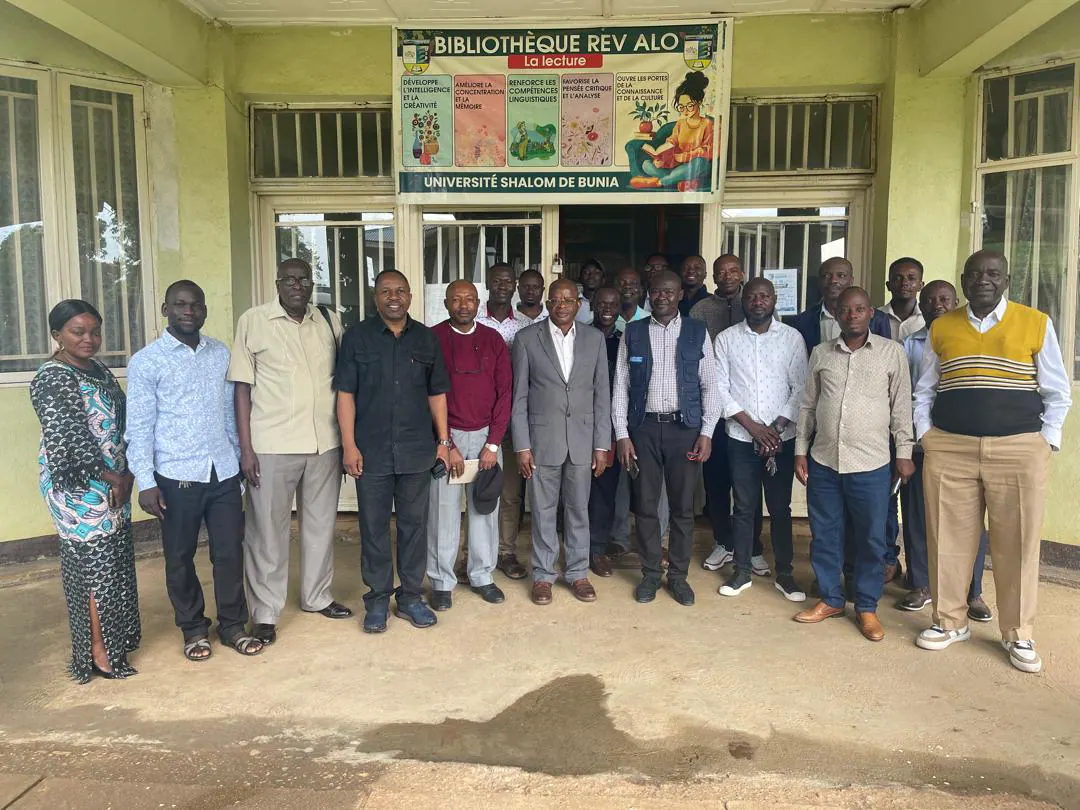
The scientific and academic staff of University Shalom de Bunia in the Ituri province of the Democratic Republic of Congo recently participated in the 2026 general assembly of the Electronic Information for Libraries (EIFL) international organization. The assembly, which was held online due to regional tensions, focused on evaluating activities and developments in scientific information. According to EIFL's country representative, Jean-Baptiste Unen Ushanda, the university's participation demonstrates its commitment to developing access to scientific information and staying connected to academic world developments.
The EIFL general assembly, initially scheduled to take place in Tashkent, Uzbekistan, was moved online to allow members and partners to participate remotely. During the assembly, participants reviewed the organization's annual report, presented by EIFL's executive director, Rima Kupryte. The report covered EIFL's main achievements and activities from 2024 to 2026. Discussions also centered on the use of artificial intelligence (AI) in scientific publications, including the challenges and developments related to AI in research and scientific communication.
The assembly included a practical demonstration of institutional access to a scientific resource platform, which was organized for the benefit of University Shalom de Bunia's staff. This exercise allowed participants to better understand the modalities of access and use of scientific resources available on the platform. According to Unen Ushanda, the participation of university staff in this international meeting provided an opportunity for them to follow developments in scientific information, academic publications, and artificial intelligence.
University Shalom de Bunia's participation in the EIFL general assembly reflects the institution's commitment to advancing scientific research and academic excellence. By engaging with international experts and organizations, the university's staff can stay up-to-date on the latest developments in their fields and contribute to the advancement of knowledge. The EIFL organization plays a crucial role in promoting access to scientific information and supporting the development of libraries and research institutions worldwide.
The use of artificial intelligence in scientific publications was a key topic of discussion during the assembly. Participants explored the benefits and challenges of AI in research and scientific communication, highlighting its potential to improve the efficiency and quality of scientific work. The EIFL organization is working to support the development of AI-related skills and expertise in the scientific community, particularly in developing countries.
The EIFL general assembly also provided a platform for participants to share experiences and best practices in the field of scientific information and library development. The organization brings together experts and professionals from around the world to discuss key issues and developments in the field. By participating in this international event, University Shalom de Bunia's staff can learn from others and share their own experiences, contributing to the global exchange of knowledge and ideas.
In conclusion, the participation of University Shalom de Bunia's staff in the EIFL general assembly is a significant step towards advancing scientific research and academic excellence in the Democratic Republic of Congo. The event provided a valuable opportunity for the university's staff to engage with international experts, learn about the latest developments in scientific information and AI, and contribute to the global scientific community.
Key points
- University Shalom de Bunia staff participate in EIFL general assembly to discuss scientific information and AI.
- The assembly was held online due to regional tensions, allowing members and partners to participate remotely.
- The event provided an opportunity for university staff to follow developments in scientific information, academic publications, and artificial intelligence.