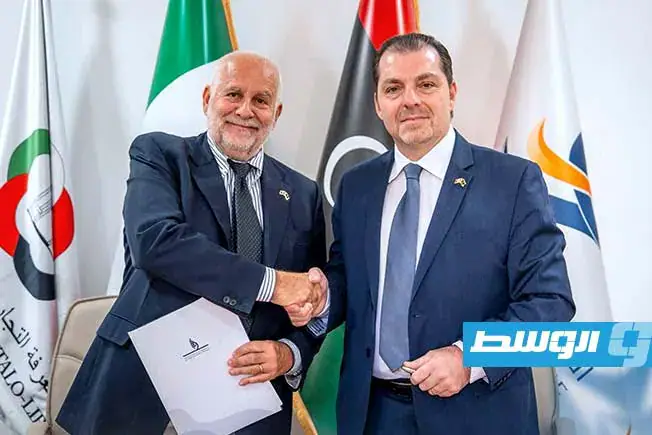
A five-day Italian trade mission to Libya concluded with the signing of two cooperation agreements in maritime transport and animal health, as well as the opening of a permanent office for the Italian-Libyan Chamber of Commerce in Misrata's free zone. The mission, led by Nicola Collichi and organized by the Italian-Libyan Chamber of Commerce, the Italian Embassy in Tripoli, and the Italian Union of Chambers of Commerce, included over 50 Italian companies and representatives from various institutions. The visit aimed to explore investment opportunities and build new business partnerships.
The Italian delegation, which visited Misrata and Tripoli, participated in a business and investment forum hosted by the Misrata Free Zone. The forum resulted in the opening of a permanent office for the Italian-Libyan Chamber of Commerce, providing a continuous point of contact for Italian companies interested in entering the Libyan market. The office will facilitate communication with local companies and follow up on cooperation opportunities and business projects discussed during the forum.
Two agreements were signed during the visit. The first agreement was between the Misrata Free Zone and the West Sicily Port Authority, aiming to enhance commercial and logistical links between Libya and Sicily. The second agreement was between the Italian-Libyan Chamber of Commerce and the Experimental Institute for Animal Health "Togo Rosati". The agreements focus on cooperation in maritime transport, animal health, food safety, training, and technology transfer.
The Italian companies had the opportunity to visit several industrial facilities in Misrata, including the Libyan Iron and Steel Company, and factories producing agricultural and food products. These visits revealed Libya's industrial capabilities, which go beyond the commonly associated images of political crises and oil dependence. The Italian companies showed interest in Libya's market, which offers opportunities for investment and cooperation.
However, the report noted that Italian companies face competition from Turkish and Chinese companies, particularly in infrastructure, logistics, and industrial supplies. To succeed, Italian companies must offer comprehensive proposals combining industrial expertise, financing, and institutional support. The Libyan market presents challenges, including complex administrative procedures, payment issues, and currency fluctuations.
The Italian Ambassador to Libya, Gianluca Alberini, expressed support for Italian companies willing to invest and work in the Libyan market. He emphasized that Italy is a welcome partner in Libya, with a strong presence in various sectors, including economy, security, defense, and education. The Italian Embassy and the Investment and Import-Export Office in Tripoli, as well as the Consulate General in Benghazi, provide institutional support to Italian companies operating in Libya.
The Italian-Libyan Chamber of Commerce plans to continue efforts to connect companies in both countries through future meetings, following up on contacts made during the mission. The success of the visit will be evaluated based on the ability of Italian companies to convert these contacts into commercial contracts, investments, and partnerships in a market that offers promising opportunities but also presents ongoing challenges.
Key points
- The Italian trade mission resulted in two cooperation agreements and the opening of a permanent office in Misrata.
- Italian companies face competition from Turkish and Chinese companies in the Libyan market.
- The Italian Embassy and other institutions provide support to Italian companies operating in Libya.