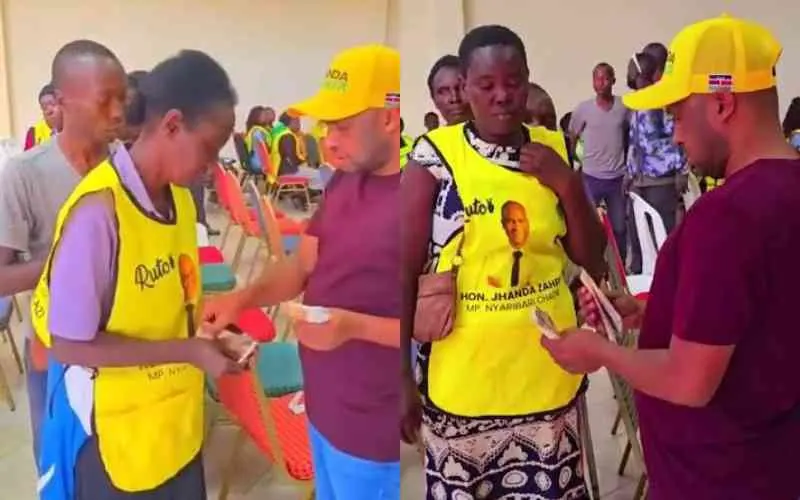
For many years, Kenyan politics has had a complicated relationship with money. The practice of politicians giving out cash and other forms of assistance at rallies and events has become a familiar phenomenon. As Kenya looks towards the 2027 General Election, concerns are being raised about the role of money in politics and its impact on the democratic process.
Kenya's political history has long included patronage, personal networks, and material assistance. What has changed is the scale and visibility of the practice, with social media platforms making it easier for politicians to showcase their generosity. A political contribution can now be captured on a mobile phone, uploaded to social media, and watched by thousands of people within minutes.
The Ethics and Anti-Corruption Commission's National Ethics and Corruption Survey covering the 2022 General Election found that more than 70 per cent of respondents who reported receiving electoral bribes received between Sh30 and Sh1,000. The survey also found that 17.7 per cent said bribery influenced their voting decisions, while 82.3 per cent said it did not.
The Elections Act prohibits giving money, gifts or other valuable consideration to induce voters to vote or refrain from voting for a particular candidate. However, the deeper issue is the political culture that has allowed money to become such a powerful instrument of political mobilisation. In counties like Turkana, a few hundred shillings can mean a great deal to a struggling household.
Poverty is not a political crime, but residents in counties like Turkana should not have to rely on handouts as a form of development. A bursary programme with clear eligibility criteria, a public budget, and accountability is different from a politician personally handing money to residents at a political gathering.
A young student in Turkana does not ultimately need a politician who occasionally puts Sh1,000 in their pocket; they need an education system that gives them a genuine chance to complete their studies and compete for employment. Similarly, a pastoralist does not simply need a politician to contribute to a fundraiser after livestock losses; they need reliable water, veterinary services, markets, roads, security, and policies that support pastoral livelihoods.
The same reality can be seen in Nairobi, where residents in informal settlements like Kibera, Mathare, Mukuru, or Korogocho may struggle to put food on the table and may see handouts as an attractive option. However, this highlights the need for a more sustainable and equitable approach to addressing poverty and inequality.
Key points
- The role of money in Kenyan politics has raised concerns about the impact on the democratic process.
- The Ethics and Anti-Corruption Commission's survey found that 17.7 per cent of respondents said bribery influenced their voting decisions.
- There is a need for a more sustainable and equitable approach to addressing poverty and inequality in Kenya.