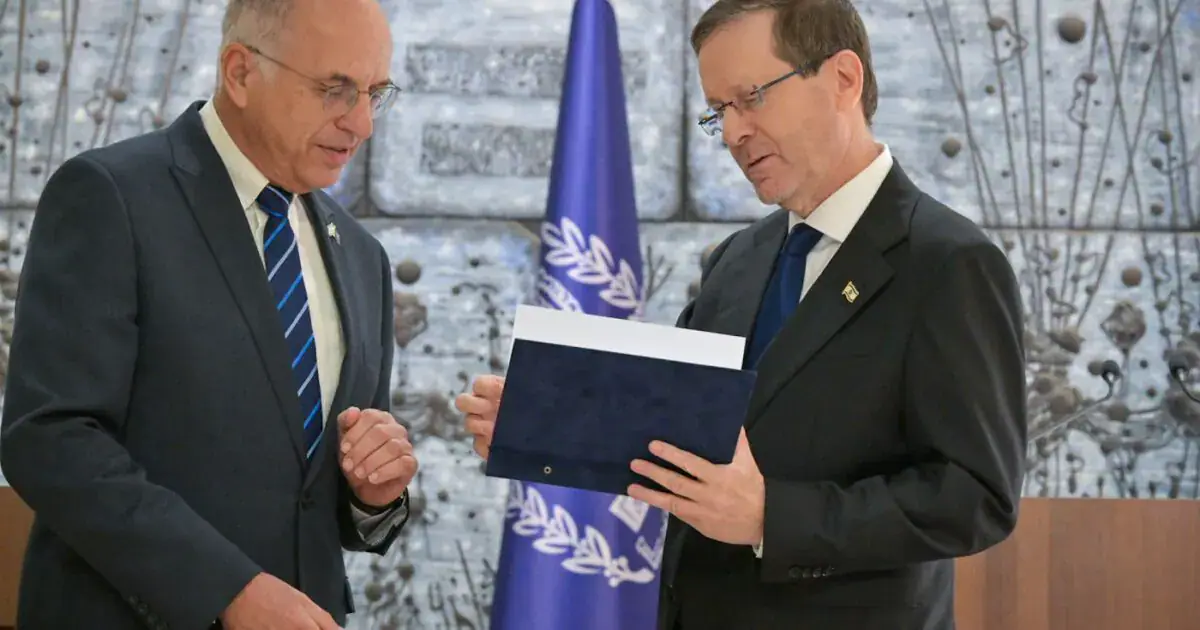
Israel's President Isaac Herzog is set to consult with factions that will represent the Israeli electorate in the Knesset, receiving their recommendations on who they believe is best suited to form a government. The consultations will be broadcast via his office's YouTube channel. Currently, Gadi Eisenkot, who heads the change bloc, appears likely to be tapped by Herzog to form a coalition. The big question Israelis are asking is whether they will have a functioning government or be headed to the polls again.
The recent election results have come with significant surprises. While Likud won the most seats, the "Pro-Netanyahu" bloc fell short of the majority. In a shock development, the ultra-Orthodox party United Torah Judaism (UTJ), which won seven seats, said it is unlikely to recommend Benjamin Netanyahu to form a coalition. This leaves Netanyahu with Shas and the far-right Otzma Yehudit and Religious Zionist Party, headed by Itamar Ben-Gvir and Bezalel Smotrich respectively.
The ultra-Orthodox (Haredi) parties underperformed in the election, but the Arab parties, comprised of The Joint List and Ra'am, won 19 seats, making them the third biggest bloc. Arab voters are not homogenous, and while some parties are politically and ideologically opposed, many in the Arab communities do not vote for them. Israel's Arabs see high crime as one of their most pressing concerns and do not want a repeat performance from Ben-Gvir.
The "anti-Bibi" or "change bloc", headed by Eisenkot, accumulated 48 seats but fell short of the majority. The bloc is likely to be offered to form a coalition first. There is a possibility that the Arab bloc and UTJ sit outside of the coalition. The change bloc realizes it has to move fast and has released a statement saying they will act immediately to replace the current government with a national emergency government.
The party leaders are coordinating regarding the need to establish a Zionist government based on the four principles set forth by Eisenkot. However, nobody wants to go to another election, and there is a question of whether there can be compromise. A unity or broad-based government seems highly unlikely due to the refusal of some factions to sit with Netanyahu. Avigdor Liberman, the Arab bloc, Eisenkot, Yair Golan, and possibly UTJ have said they will not sit with Netanyahu.
Israelis are feeling the uncertainty and shifting sands, with many war-fatigued and wary about the future. The conversation has become less about the election results and more about the possibility of renewed war with Iran. The war drums beat louder, and the rhetoric on all sides becomes more strident. Israelis are also watching the US midterms closely, as a projected Democratic win could have serious consequences for the "unshakeable alliance" between Israel and the US.
In the midst of uncertainty and potential change, Israelis will do what they do in times of change - they will adapt. Despite the war drums and uncertainty, singer Boy George is set to perform in Israel. The Israeli public is bracing for a seismic change in the US and navigating the complexities of their own government's formation.
Key points
- Israel's President Isaac Herzog to consult with factions on forming a government after a contentious election.
- The "change bloc" headed by Gadi Eisenkot may be offered to form a coalition first.
- A possible renewed war with Iran and a win for the Democratic Party in the US midterms could challenge Israel and the US's iron-clad alliance.