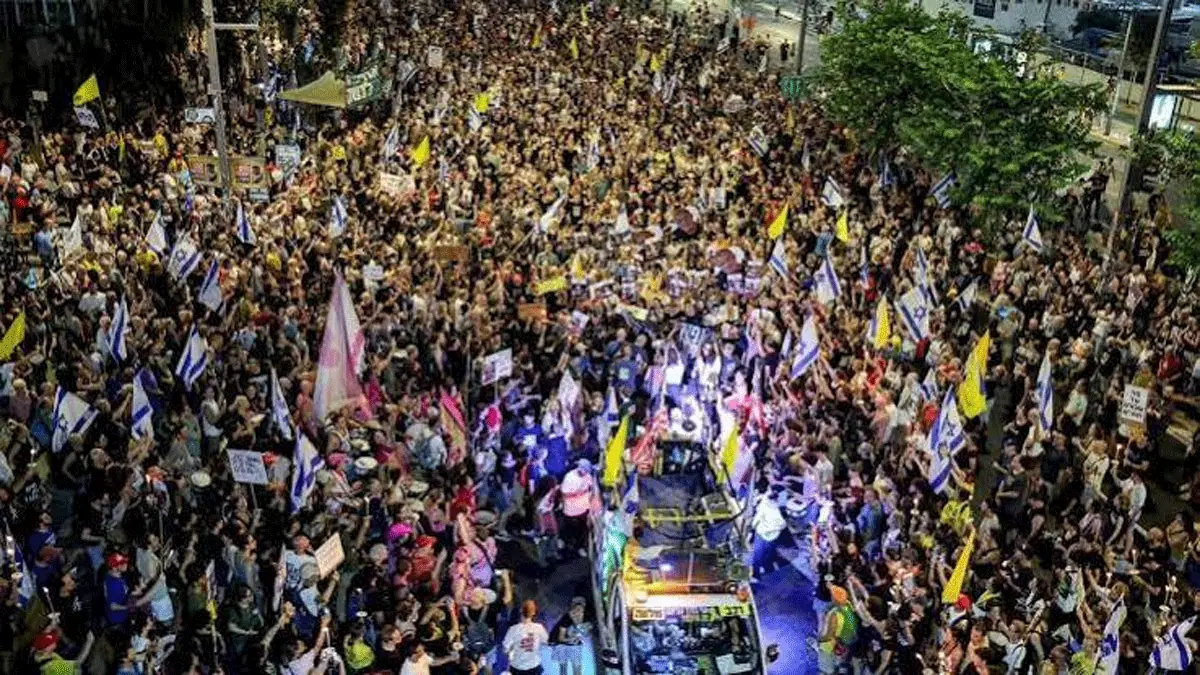
On October 31, 2026, approximately 2,000 people gathered in Tel Aviv to demand the formation of a government that brings together Jewish and Arab parties. The protest, organized by the judéo-arabe movement Standing Together, took place after the legislative elections that left Israel without a clear majority government. The protesters assembled at Habima Square and marched to Rabin Square, urging parties opposed to Benjamin Netanyahu to build a majority that includes Arab political formations.
The protest was a response to the October 27, 2026, legislative elections, which resulted in a highly fragmented Knesset. According to several media outlets, Netanyahu's bloc secured 53 seats, while the opposition, led by Jewish officials, obtained 48 seats, and Arab parties won 19 seats. Although the opposition and Arab parties combined have 67 seats, exceeding the 61 needed for a parliamentary majority, forming a coalition government remains challenging. Several parties opposed to Netanyahu refuse or condition their cooperation with Arab parties.
The 19 Arab seats are crucial in the negotiations, but their participation in a future government is not guaranteed. The protest in Tel Aviv was not without controversy, as around 200 Netanyahu supporters demonstrated in response, some of whom alleged electoral fraud, claims that have not been substantiated. The new Knesset is set to take office on November 10, 2026, and politicians must continue negotiations to form a stable coalition.
The protesters' demands reflect a desire for a more inclusive government, with representatives from both Jewish and Arab communities. Similar rallies were also reported in Jerusalem and Haifa. The movement Standing Together has been advocating for a united Israel, where Jewish and Arab citizens can work together to build a more cohesive society.
The challenges in forming a government are compounded by deep-seated divisions between parties. Netanyahu's opponents face significant hurdles in forming a coalition, as some are reluctant to work with Arab parties. The Arab parties' 19 seats could be pivotal in determining the next government's composition, but their participation is not assured.
The situation remains uncertain, with multiple possible outcomes. The Knesset's new members will take office soon, and the next government will need to address pressing issues, including economic and security concerns. The protesters in Tel Aviv have made their voices heard, calling for a more inclusive and representative government.
As the negotiations continue, all parties face pressure to find common ground and form a stable coalition. The experience of previous governments has shown that building a coalition that includes Arab parties can be difficult, but not impossible. The coming days will be crucial in determining the course of Israeli politics and the shape of its next government.
Key points
- The protest in Tel Aviv called for a government that includes both Jewish and Arab parties.
- The October 27, 2026, legislative elections resulted in a highly fragmented Knesset.
- The 19 Arab seats are crucial in the negotiations to form a government.