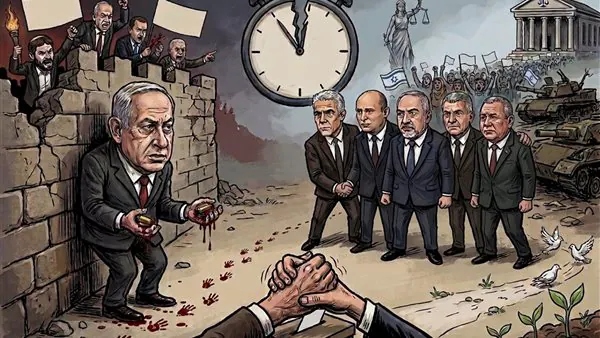
In a significant development ahead of the October 27 Israeli legislative elections, five opposition leaders met at the home of Yair Lapid, leader of the "There is a Future" party, to form an alliance aimed at ousting Prime Minister Benjamin Netanyahu from power. The meeting, which took place on Saturday, brought together Lapid, former Prime Minister Naftali Bennett, Avigdor Lieberman, leader of the "Israel is Our Home" party, Yair Golan, leader of the "Democrats" party, and Gadi Eisenkot, former Chief of Staff of the Israeli army.
The opposition leaders, who have formed an alliance dubbed "Together," expressed confidence in their ability to secure a majority in the Knesset, Israel's parliament, and thereby unseat Netanyahu, who has been in power intermittently for 30 years. According to reports, the alliance aims to increase voter turnout and prepare for election day, while also working to prevent Netanyahu's Likud party from winning.
The formation of the opposition alliance comes as Netanyahu faces mounting criticism over his handling of the Israeli-Palestinian conflict and his government's policies. Netanyahu, who is required to appear before the International Criminal Court on charges of war crimes and crimes against humanity related to the Israeli aggression on Gaza, has been accused of pursuing a policy of "war mongering." His government has been involved in several conflicts on multiple fronts over the past three years.
Notable absentees from the meeting included Benny Gantz, leader of the "Blue and White" party and former Defense Minister, who has yet to decide whether to run in the elections. Gantz has expressed concerns about the feasibility of forming a government without Netanyahu's Likud party and has called for a "Zionist unity government." His party has been critical of Netanyahu's policies, particularly with regard to the Israeli-Palestinian conflict.
The opposition leaders have published a joint document outlining their shared principles and goals, which include increasing voter turnout, preparing for election day, and preventing Netanyahu's Likud party from winning. The document also calls for the formation of three working groups to focus on voter turnout, government formation, and media coordination.
Netanyahu has responded to the opposition alliance by accusing them of seeking to form a government with the support of Arab parties. He has vowed to continue campaigning and has expressed confidence in his ability to win the elections. His allies, including Finance Minister Bezalel Smotrich, have also criticized the opposition alliance, with Smotrich describing it as "dangerous."
The upcoming Israeli legislative elections are seen as a critical test of Netanyahu's popularity and his ability to maintain power. The opposition alliance's efforts to unseat him have added a new layer of complexity to the campaign, with many voters eagerly awaiting the outcome. The elections will determine the future of Israeli politics and the direction of the country.
Key points
- Israeli opposition leaders form alliance to oust Prime Minister Benjamin Netanyahu ahead of October 27 legislative elections.
- Netanyahu faces criticism over his handling of the Israeli-Palestinian conflict and his government's policies.
- The opposition alliance aims to increase voter turnout and secure a majority in the Knesset to unseat Netanyahu.