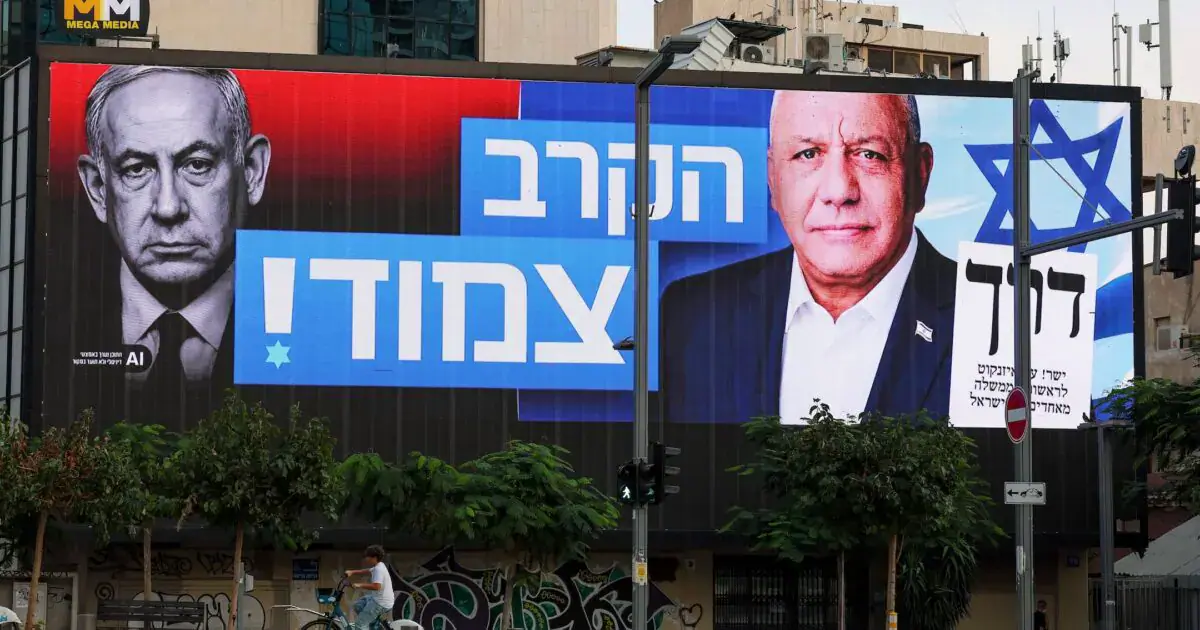
Israeli Prime Minister Benjamin Netanyahu and his opponent Gadi Eisenkot face significant challenges in forming a government after the recent elections. Netanyahu's Likud party and Eisenkot's Yashar party garnered the most votes, but neither secured a clear majority. Netanyahu's bloc has 53 seats, while Eisenkot's bloc has 48. Both leaders will need to negotiate with other parties to form a coalition government.
Eisenkot's bloc consists of four Jewish Israeli parties: Yashar, B'Yachad, Israel Beiteinu, and The Democrats. To form a government, Eisenkot may need to align with Arab parties, which could be difficult given that three of his bloc's parties explicitly pledged not to form a government with them. Eisenkot himself has also stated that he does not intend to form a government with Arab parties. During the campaign, he set conditions for joining his government, including a commitment to Israel as a Jewish and democratic state.
One possible option for Eisenkot is to form a minority government that would depend on votes from Arab parties. However, this approach may face significant opposition. The Joint List, an Arab party with 11 seats, stated that it was willing to engage in "political cooperation to bring down Netanyahu's government" but did not clarify whether it would support an Eisenkot-led government. Ra'am, another Arab party with eight seats, expressed willingness to work with politicians from both blocs.
Another challenge for Eisenkot and Netanyahu is the issue of ultra-Orthodox exemption from military service. All four parties in Eisenkot's bloc made ending this exemption a central campaign issue, but the ultra-Orthodox parties, Shas and United Torah Judaism, have promised their constituents that they would not allow for forced conscription. Cooperation with these parties would require breaking campaign promises.
A national unity government between Eisenkot's bloc and Netanyahu's bloc is also a possibility, but this would also require breaking campaign promises. Eisenkot, Netanyahu, and other leaders have stated that they would not sit in a government with each other. Netanyahu has been a contentious figure, and some leaders have cited his policies as a reason for not wanting to work with him.
Netanyahu also faces challenges in forming a government, despite his bloc securing 53 seats. He would need to secure an additional eight seats to achieve a majority. During the campaign, Netanyahu deployed the prospect of cooperation with Arab parties as a way to bash the opposition, but it is unclear whether he would be willing to work with them. His ultra-nationalist partners have made it clear that they would not support cooperation with Arab parties.
The challenges in forming a government in Israel may require a fundamental breach of campaign promises or another election. The situation highlights the complexities of Israeli politics and the difficulties of forming a coalition government. Ultimately, the leaders will need to make difficult decisions to form a government that can effectively lead the country.
Key points
- Eisenkot and Netanyahu may need to break campaign promises to form a government.
- The issue of ultra-Orthodox exemption from military service is a major challenge in forming a government.
- A national unity government between Eisenkot's bloc and Netanyahu's bloc is a possibility, but would require breaking campaign promises.