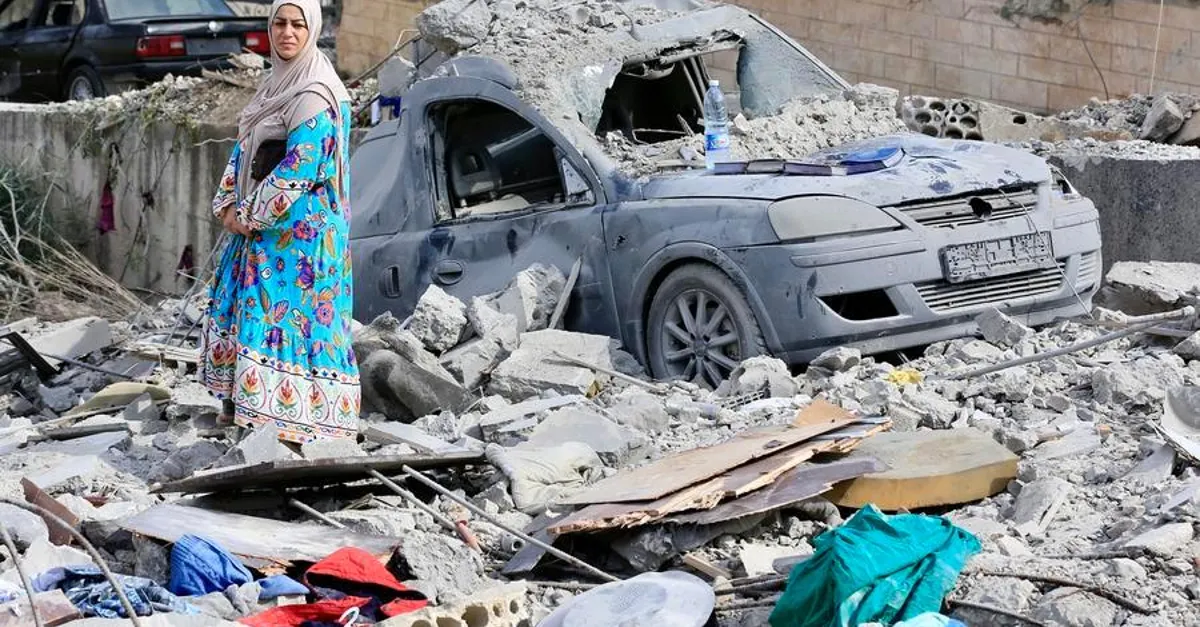
Israeli forces continued their aggression on southern Lebanon on Monday, conducting airstrikes and artillery fire on various areas. According to the Lebanese National News Agency, Israeli aircraft targeted Wadi Zbeqin, alongside raids on the outskirts of Kfar Tabnit and Harj Ali Taher near Nabatieh al-Fawqa. The attacks resulted in significant damage and raised concerns about escalating tensions in the region.
The Israeli military also carried out artillery fire on Nabatieh al-Fawqa, Zouq al-Sharqeeya, and Khaleh Mivdon, located between Zouq al-Sharqeeya and Mivdon in the Nabatieh district. Additionally, the towns of Beit Lif, Haddatha, and the outskirts of Baraachit in the Bint Jbeil district were targeted. The continued aggression has led to widespread fear and displacement among local residents.
Israeli forces also launched illuminating shells into the skies above the towns of Zouq al-Sharqeeya, Merkaba, Houla, and Haddatha. Furthermore, they conducted heavy machine gun sweeping operations on the towns of Sarbin and Haddatha, as well as the outskirts of Mays al-Jabal, Wadi al-Salouqi, and Wadi Zbeqin. These actions have heightened concerns about a potential escalation of violence in the region.
The Israeli military also dropped illuminating bombs over several villages in the western and central sectors, coinciding with demolition operations in the town of Al-Mansouri. The ongoing tensions have raised concerns about the stability of the region and the potential for further conflict.
The Israeli-Lebanese conflict has a long and complex history, with multiple attempts at peace negotiations. In June, Lebanon and Israel reached a framework agreement, facilitated by the United States, which included arrangements for a gradual deployment of the Lebanese army and Israeli withdrawal. However, the implementation of the agreement has faced significant obstacles.
The continued Israeli aggression on southern Lebanon has resulted in significant humanitarian concerns, with many residents displaced or affected by the violence. The international community has called for restraint and a return to peace negotiations to resolve the conflict.
The situation remains volatile, with concerns about the potential for further escalation. The Lebanese government has urged international intervention to stop the Israeli aggression and protect the country's sovereignty. The conflict has also raised concerns about regional stability and the potential for wider conflict.
Key points
- Israeli forces have continued their aggression on southern Lebanon, conducting airstrikes and artillery fire on multiple areas.
- The conflict has resulted in significant humanitarian concerns, with many residents displaced or affected by the violence.
- The implementation of the Israeli-Lebanese framework agreement has faced significant obstacles, contributing to ongoing tensions.