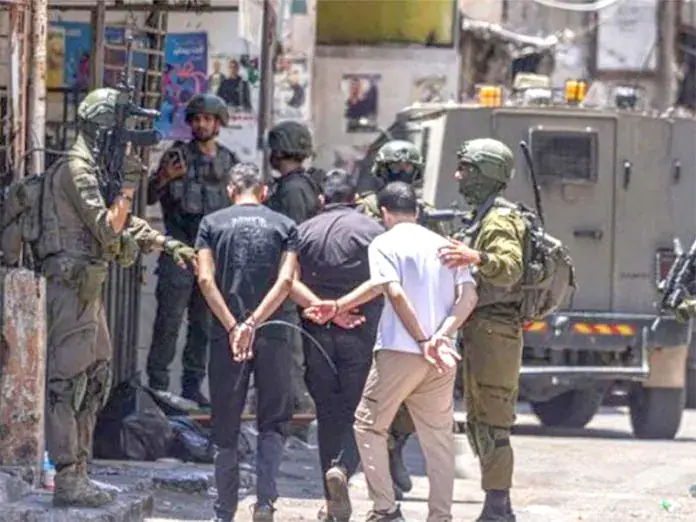
Israeli forces have arrested 110 Palestinians in the El-Khalil governorate, including seven children and three women, since the start of their aggression six days ago. The arrests have targeted former detainees, people with disabilities, and families of martyrs, according to the Palestinian Prisoners' Club. The organization says the mass arrests and expanded operations indicate the use of detention as a means of pressure and collective punishment.
The arrests have been accompanied by interrogations, beatings, and mistreatment of hundreds of citizens in the streets, at military checkpoints, and inside homes. The forces have also closed roads and restricted movement, paralyzing daily life and hindering access to work and essential services. Families have been forced to leave their homes, and the situation has affected not only those arrested but also their families and social environment.
The El-Khalil municipality reported that around 780 families have been affected by the aggression, with nearly 5,000 residents either displaced or besieged in their homes. The situation is critical in two neighborhoods under tight siege since last Friday. Four Palestinians were arrested in raids in Doura and Al-Fawwar camp, south of the governorate, with their homes being searched and ransacked.
The UN High Commissioner for Human Rights, Volker Türk, warned that the operation in El-Khalil raises serious concerns about the risk of ethnic cleansing. He cited the destruction of homes and commercial property, as well as restrictions on residents' freedom of movement. The UN Office for the Coordination of Humanitarian Affairs (OCHA) reported that its partners are supporting local authorities to respond to the needs of over 3,000 people displaced since Friday.
Meanwhile, several areas in the occupied West Bank have witnessed new settler attacks over the past 24 hours. Olive pickers and Palestinian homes have been targeted, with electrical networks damaged and crops and agricultural equipment stolen. Farmers have been injured in the village of Deïr Jarir, east of Ramallah. The attacks have concentrated in the governorates of Nablus, Ramallah, and Qalqilya, with some attacks carried out under the protection of Israeli forces.
In Deïr Jarir, Palestinians were injured during an attack by settlers on olive pickers, with the army providing protection. Another attack targeted farmers harvesting olives in Beït Ur al-Tahta, west of Ramallah, with settlers acting alongside Israeli forces. In Qalqiliya, pickers were also attacked in the Al-Batin area of Immatin. Habitations, electrical networks, and crops have been targeted, exacerbating the difficulties faced by Palestinian families during the harvest season.
The situation has worsened in the Jordan Valley due to heavy rainfall, with residents facing harsh living conditions amidst restrictions and settler attacks. The vulnerability of residents has increased, particularly in areas with limited access to basic services. The international community has expressed concern over the escalating violence and its impact on civilians, with calls for restraint and protection of human rights.
Key points
- Israeli forces have arrested 110 Palestinians in El-Khalil, including children and women.
- Settlers have launched attacks on farmers, homes, and infrastructure in several areas of the occupied West Bank.
- The UN has expressed concern over the risk of ethnic cleansing and the humanitarian situation in the affected areas.