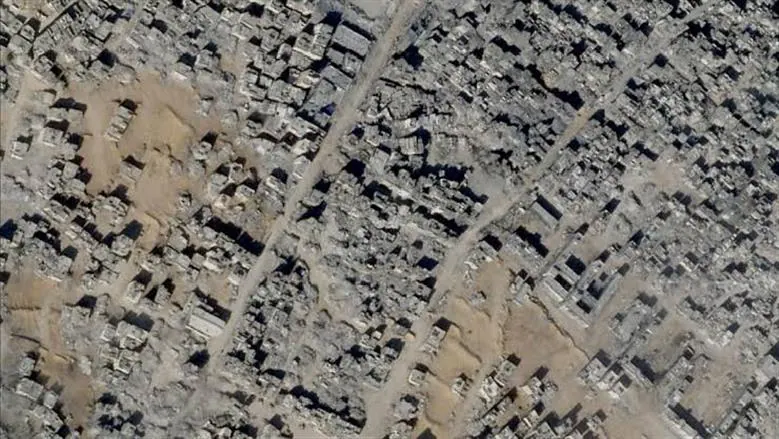
Despite a ceasefire agreement between Israel and Hamas that came into effect nearly a year ago, satellite images show that Israeli forces have continued to expand their presence in Gaza. According to an analysis by The New York Times, Israeli forces have not only maintained their existing positions but have also established at least 12 new advanced military sites. These actions indicate a significant expansion of Israel's control within Gaza.
The ceasefire, which took effect in October 2025, led to the withdrawal of Israeli forces to positions defined by the so-called "Yellow Line." This line was intended to mark the boundary of Israel's control, with Israel maintaining about 53% of Gaza's territory. However, satellite images reveal that Israeli forces have gradually advanced beyond this line, setting up concrete blocks and significant earthen barriers, some nearly a mile inside Gaza.
Israel has also established what it describes as the "Orange Zone," a restricted area where Palestinians and humanitarian organizations must coordinate with the Israeli military to move in or through. The New York Times' analysis found that at least six new military sites were created within this zone after the ceasefire, many on the ruins of homes and villages destroyed during the conflict.
On the Israeli-controlled side of the "Yellow Line," extensive areas of Gaza appear devastated or largely uninhabited, with thousands of buildings destroyed since the ceasefire began. Satellite images indicate ongoing demolition efforts during the ceasefire period, including the destruction of over 100 buildings south of Deir al-Balah between late August and early September.
The expansion of Israeli control has significant implications for the residents of Gaza. With most of Gaza's nearly 2 million residents living in a smaller area controlled by Hamas, the situation on the ground appears to be solidifying a temporary division into a more permanent reality. Analysts and diplomats suggest that these actions could undermine efforts toward a lasting peace.
Plans for reconstruction in Gaza are complicated by the ongoing conflict and security concerns. Officials from the Trump administration's Peace Council indicate that the United Arab Emirates plans to build a housing complex for displaced Palestinians in areas controlled by Israel. However, Palestinian officials express concerns that such plans may not address the underlying issues of control and disarmament.
Israeli Prime Minister Benjamin Netanyahu has reiterated that Israel will not withdraw from the buffer zone unless Hamas disarms. During a visit to a controlled area within Gaza in early September, Netanyahu stated, "We control about 60% of the land, and our hands are still open." This stance suggests that Israel's military presence in Gaza is likely to continue in the near term.
Key points
- Israel's expansion in Gaza despite a ceasefire agreement has significant implications for the region's stability and peace efforts.