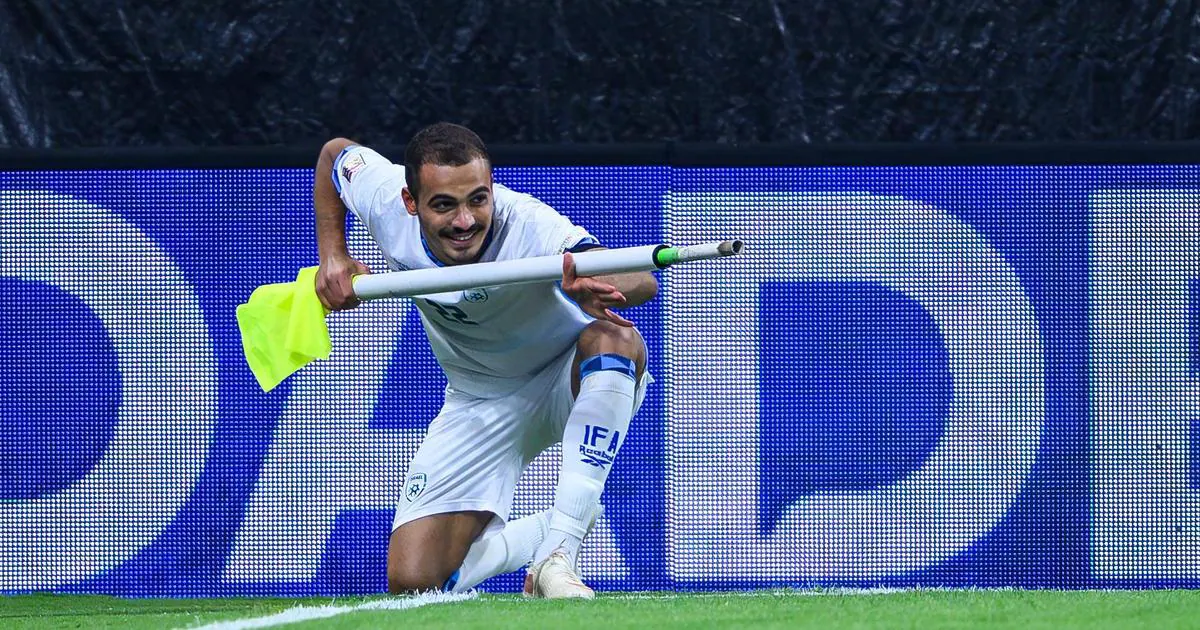
Israel forward Sayed Abu Farchi was dismissed during his side's UEFA Nations League clash against Austria on Thursday night. The 20-year-old attacker received a second yellow card for celebrating his goal with a simulated gun gesture, leaving Israel with 10 players as Austria eventually secured a 3-1 victory at the Raiffeisen Arena in Linz. Abu Farchi had brought Israel level early in the second half, heading home in the 55th minute to cancel out Romano Schmid's first-half penalty.
Abu Farchi's celebration quickly turned the spotlight away from the goal. After scoring, he ran towards the corner before removing the corner flag. The Israel international then dropped onto his right knee and positioned the flagpole across his body, using his left hand as though he were holding a weapon before making a firing gesture. The referee immediately intervened and showed Abu Farchi a second yellow card. He had been booked just four minutes earlier, meaning the celebration resulted in a red card and an early exit from the match.
The Laws of the Game allow players to celebrate after scoring, but there are limits on how that celebration can be conducted. Under Law 12 of the International Football Association Board (IFAB), players are permitted to celebrate a goal, but celebrations must not be excessive. A player can also be cautioned if the celebration is considered provocative, derisory, or inflammatory. The law specifically provides referees with grounds to issue a yellow card for certain forms of goal celebration, including gestures that are deemed provocative or inflammatory.
In Abu Farchi's case, the referee interpreted the simulated shooting gesture as falling within the provisions of Law 12. Because the forward had already received a yellow card moments earlier, the second caution automatically resulted in a red card. Abu Farchi, who plays his club football for MLS side Colorado Rapids, was therefore dismissed despite having just helped Israel equalise. The incident has sparked debate about the boundaries of goal celebrations and the role of referees in enforcing the laws of the game.
The UEFA Nations League match between Austria and Israel was played on September 25, 2026, at the Raiffeisen Arena in Linz. Austria secured a 3-1 victory, with Romano Schmid scoring a first-half penalty before Abu Farchi's equaliser. The home team scored two more goals in the second half to seal the win. The result has implications for the group stage standings, with Austria moving up the table and Israel facing a tougher challenge to qualify.
The incident involving Abu Farchi has sparked reaction on social media, with many fans and pundits discussing the merits of the red card. Some have argued that the celebration was not excessive and did not warrant a second yellow card, while others have defended the referee's decision. The debate highlights the challenges faced by referees in balancing the need to maintain order on the pitch with the desire to allow players to express themselves during goal celebrations.
The red card will see Abu Farchi miss Israel's next UEFA Nations League match, potentially impacting his team's chances of progressing to the next stage. The Israeli team will need to regroup and focus on their upcoming matches, with the aim of securing crucial points to boost their group stage prospects. The incident will also be reviewed by the Israeli football authorities, with a view to supporting Abu Farchi and ensuring that he understands the laws of the game.
Key points
- Israel forward Sayed Abu Farchi was sent off for a simulated gun gesture during the UEFA Nations League match against Austria.
- The Laws of the Game allow for players to be cautioned for excessive or provocative goal celebrations.
- The red card will see Abu Farchi miss Israel's next UEFA Nations League match.