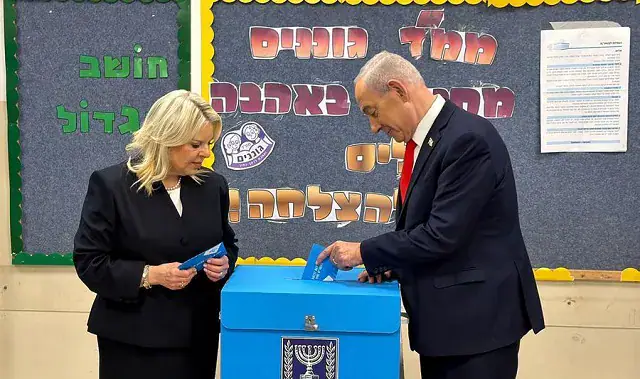
Israel's parliamentary election has ended without a clear winner, leaving the country in a state of political uncertainty. With approximately 85 percent of votes counted, Prime Minister Benjamin Netanyahu's right-wing and religious bloc is projected to secure 53 seats in the 120-seat parliament. His main rival, former military chief Gadi Eisenkot, is expected to win 48 seats with his opposition bloc. The Arab-majority parties, comprising the Joint List and the Muslim Ra'am party, are projected to secure a combined 19 seats.
The outcome of the election has sparked concerns about the country's ability to form a government. Analysts point to several possible scenarios, including prolonged coalition negotiations, a unity government, or another round of elections. The Arab parties, which could hold the key to breaking the deadlock, have expressed willingness to support Eisenkot's "change bloc." However, both Netanyahu and Eisenkot have rejected forming a government dependent on Arab parties. The final official results are expected by November 4, according to Israel's Central Elections Committee.
Israel's proportional electoral system adds to the uncertainty, as parties must win at least 3.25 percent of the national vote to enter parliament. Minor shifts in voting margins could significantly alter the distribution of seats. The votes cast under special voting arrangements, including those by soldiers, diplomats abroad, and hospital patients, have yet to be counted. This could potentially change the final tally and impact the formation of the next government.
The process of forming the next government is complex and involves several steps. Following the publication of official results, President Isaac Herzog will consult with representatives of elected parties before assigning the mandate to the lawmaker he deems most likely to assemble a viable majority. The designated candidate will have 28 days to negotiate a coalition, with a possible extension of up to 14 days. If negotiations fail, the president can assign another lawmaker to try to assemble a government.
Arab parties could play a crucial role in determining the next prime minister. The Joint List and Ra'am party have expressed willingness to support Eisenkot's bloc. Ra'am leader Mansour Abbas said his party wants to join a coalition led by the bloc. Joint List leader Yousef Jabareen said the alliance is "ready and prepared to pave the way" for replacing Netanyahu's government through a partnership with Eisenkot's bloc. However, both Netanyahu and Eisenkot have ruled out forming a government dependent on Arab parties.
Despite the challenges, President Herzog has urged parties to avoid another round of elections. He said every effort must be made to prevent a costly deadlock. One possible outcome could be a minority government supported by Arab lawmakers from outside the coalition. This would require Eisenkot to reverse his election pledge against partnering with Arab parties. Such reversals are not unprecedented in Israeli politics, where coalition negotiations often force party leaders to compromise on campaign promises.
The uncertainty surrounding Israel's government formation has sparked concerns about the country's stability. If all coalition attempts prove unsuccessful, parliament will automatically dissolve, forcing Israel into another election and extending the political stalemate for months. In the interim, Netanyahu and his outgoing cabinet would remain in office as a caretaker government until a new government is formed. The international community is watching closely, as Israel's political stability has implications for the region.
Key points
- Arab parties could hold the key to breaking the deadlock in Israel's parliamentary election.
- Israel's proportional electoral system adds to the uncertainty of the election outcome.
- President Isaac Herzog has urged parties to avoid another round of elections.