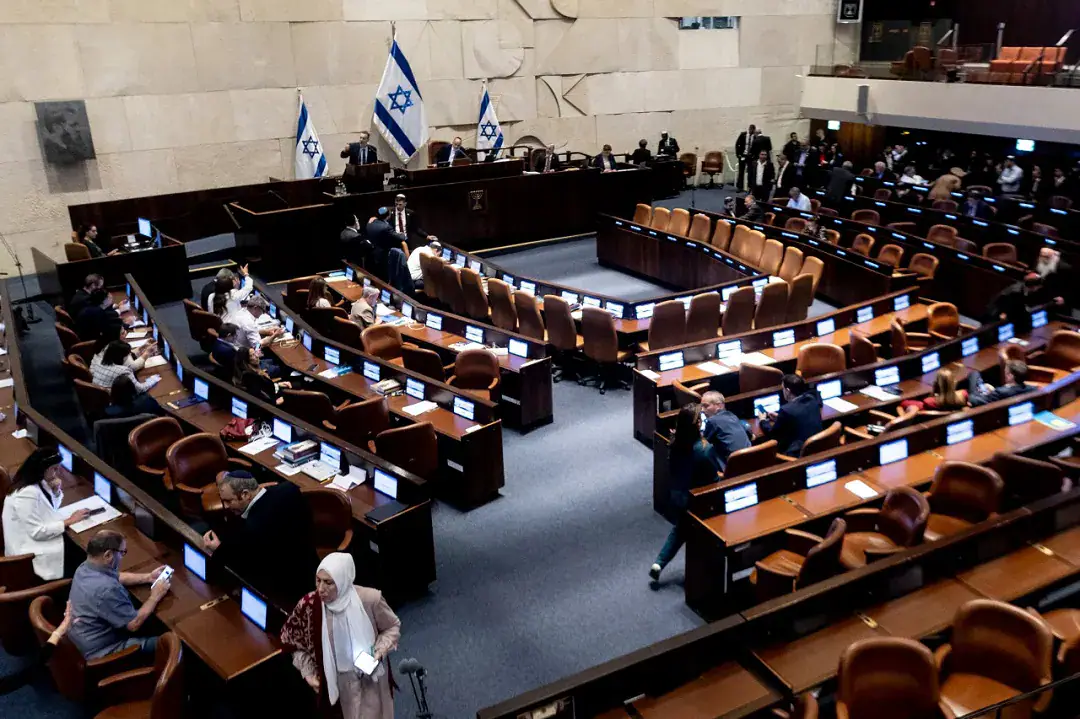
Israel's recent election has yielded no clear winner, plunging the country into weeks, possibly months, of political uncertainty. With most votes counted, Prime Minister Benjamin Netanyahu's right-wing bloc has secured around 53 seats, falling short of the 61-seat threshold required to form a government in the 120-seat Knesset. This development sets the stage for various potential outcomes and scenarios. Netanyahu's bloc has lost its majority compared to the outgoing parliament.
One possible approach for Netanyahu is to attempt to recruit an opposition party to join his government. However, all opposition parties have ruled out cooperation with him during the campaign. Those who have previously joined him have often found themselves weakened with minimal influence over policy. Another option for Netanyahu could be to seek individual opposition defectors, but this would necessitate several defections to bridge the gap. The opposition, meanwhile, has secured a parliamentary majority.
The opposition's path to power is complicated by ideological, national, and personal divisions. Netanyahu's main rival, Gadi Eisenkot, is projected to win 21 seats. However, he cannot achieve the 61-seat majority without the support of the two Arab parties, Ra'am and the Joint List, which are projected to win a record 19 seats. These parties' inclusion could be pivotal in forming a government.
Yair Golan, leader of the left-wing Democrats party, has called on his partners to consider the Arab parties as part of the bloc. He rejected what he termed Netanyahu's "racist division between Jewish and Arab votes." However, two of Eisenkot's right-wing allies have expressed opposition to forming a government that includes the Arab parties or relies on their outside support. This division within the opposition complicates the formation of a new government.
Given the apparent deadlock, another scenario is emerging: a national unity government that pairs Netanyahu's Likud with one or more opposition parties. This option would replace his current hardliner government. Although both Netanyahu and opposition leaders have ruled out this possibility during the campaign, it may become a viable solution to avoid another election. The complexity of negotiations may lead to prolonged discussions.
The current situation reflects deep divisions within Israel's political landscape. The election outcome highlights the challenges in forming a stable government. As parties begin negotiations, their strategies and potential alliances will shape Israel's political future. The involvement of Arab parties in the government or as external supporters could mark a significant shift in Israeli politics.
The international community is watching Israel's political developments closely. The country's allies and adversaries are keenly interested in the implications of its political stability for regional dynamics. As Israel navigates this complex situation, its relationships with neighboring countries and global partners may be influenced by the outcome. The path forward remains uncertain, with multiple scenarios still possible.
Key points
- Netanyahu's right-wing bloc has lost its majority in the Knesset.
- The opposition's path to power is complicated by ideological divisions.
- A national unity government is emerging as a possible solution.