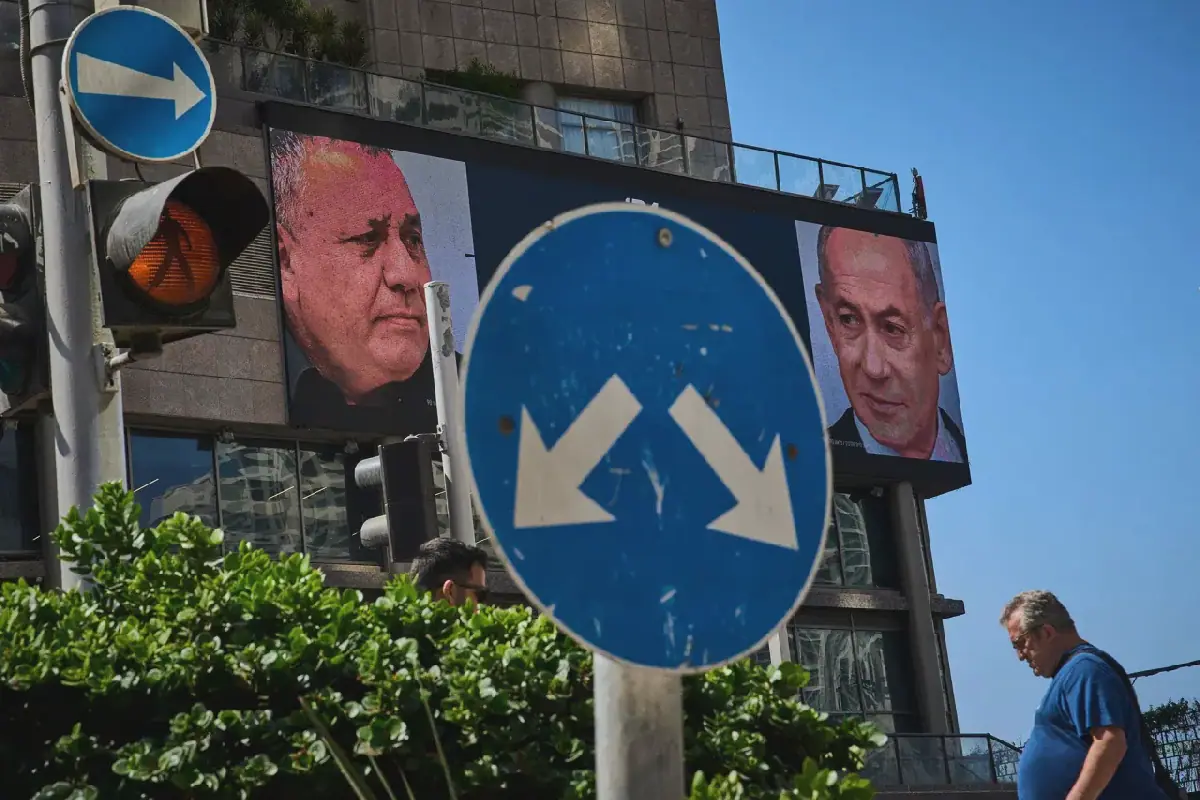
The recent Israeli election has resulted in a deadlock, with Prime Minister Benjamin Netanyahu's right-wing Likud party and the centrist Yashar party of his rival, Gadi Eisenkot, failing to secure a majority in the 120-seat parliament. This development has led to a state of political limbo, with Israel facing weeks or possibly months of uncertainty. The two main blocs have deep-rooted differences, making a straightforward coalition challenging to form. If a government is not formed within 12 weeks, Israelis may head back to the polls.
One potential scenario to avoid another election is the formation of an opposition government. This could be achieved through Jewish-Arab cooperation, but it faces significant obstacles. Two right-wing party leaders, Naftali Bennett and Avigdor Liberman, have hardened their positions against any government that includes Arab parties. Historically, only one government in Israel has had the full participation of an Arab party, which collapsed after a year in office. Despite this, opposition parties could work together to leverage their parliamentary majority and constrain Netanyahu's caretaker government.
Another option is a national unity government, which would involve the Likud party and some of its existing coalition partners, as well as at least one party from the opposition bloc. However, Netanyahu's willingness to part ways with certain far-right ministers may be limited. Eisenkot has ruled out sitting with Netanyahu, which could be seen as a betrayal by some Israelis. This scenario's feasibility is uncertain, given the deep divisions between the two blocs.
A third scenario involves Netanyahu encouraging defections from opposition parties or individual lawmakers. However, all four opposition bloc party leaders have declared they will not sit with Netanyahu. With Netanyahu's bloc eight seats short of a majority, persuading individual defectors to join his side may be a challenging task. This approach's success is uncertain, given the opposition leaders' firm stance.
Israeli President Isaac Herzog will consult with party leaders and task one of them with forming a government. The Arab parties are expected to support Eisenkot, who may be asked to attempt to form a government first. Whoever gets the nod will have 28 days to complete the task, with a possible 14-day extension. If they fail, the president will ask a second leader to try, and if necessary, a third candidate.
If no government is formed, Israel may head to another election, which could happen as early as next spring. Netanyahu, as caretaker prime minister, may have an advantage in this scenario, as he can afford to wait and potentially receive the mandate to form a government if his rival fails. A repeat election would be Israel's seventh general election in eight years, leading to a state of prolonged political paralysis.
The deadlock has significant implications for Israel's governance and stability. With no clear winner, the country may face continued uncertainty and challenges in addressing pressing issues. The various scenarios emerging from the election results will likely be closely watched by Israelis and international observers, as they could have far-reaching consequences for the country's future.
Key points
- Israel's election has ended in a deadlock, with neither main bloc securing a majority.
- Multiple scenarios have emerged to form a government, including an opposition government, national unity government, and encouraging defections.
- If no government is formed, Israel may face another election, potentially leading to prolonged political paralysis.