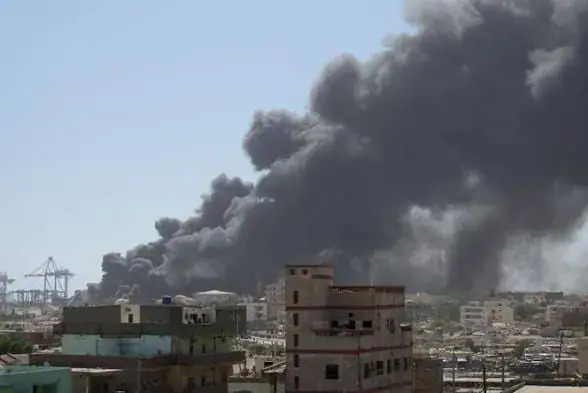
The ongoing conflict in Sudan, which began in mid-April 2023, has seen Islamist battalions allied with the Sudanese army expand their control over the Port-Soudan area. According to data collected on the ground, these battalions have been exercising significant control over the theater of operations. The existence of these Islamist battalions, also known as "shadow battalions," was first officially revealed in December 2018, following the end of Omar el-Béchir's regime.
The "shadow battalions" are affiliated with the Sudanese Islamic movement, and their existence was confirmed by Ali Osman Mohamed Taha, the former secretary-general of the movement. In a notable declaration, Taha stated, "We have shadow battalions that you know." One of the most powerful formations of the Islamic movement is the Al-Baraa Ibn Malik battalion, which was officially announced on January 7, 2020. The battalion, led by Al-Misbah Abou Zeid, joined the fighting alongside the army shortly after the conflict began.
The Al-Baraa Ibn Malik battalion has primarily been deployed in the areas around Khartoum and Omdourman. The leader of the Sudanese Islamic movement, Abdallah al-Naji, recently appeared in the Blue Nile region, presenting the Islamist battalions engaged in combat, including the Al-Baraa Ibn Malik battalion. The US has designated this battalion as a terrorist organization, and it has been targeted by sanctions from several European countries.
During his appearance, al-Naji mentioned receiving intelligence reports from Sudanese services and issued threats against Ethiopia, suggesting that the Islamic movement could target the neighboring country. He framed the conflict in Sudan as a confrontation against the US, Israel, and Jews. This appearance came after reports of his disappearance in March, when he announced his support for Iran in its conflict with the US and Israel.
Al-Naji had threatened to send Sudanese Islamist battalions to fight alongside Iran in the event of a ground intervention. He also stated that they did not recognize the UN, the Security Council, or regional organizations and revealed that they possessed advanced generations of drones. Khaled Youssef, leader of the Soumoud alliance, believes that al-Naji's recent appearance confirms that reports of his arrest were part of a tactical maneuver by the army leadership.
Youssef stated that the army leadership aimed to absorb pressure and allow time for the issue to be forgotten before things returned to normal. He also emphasized that the truth about General al-Burhan's dependence on the Muslim Brotherhood for governance and combat cannot be concealed. According to Youssef, no maneuver can mask this reality.
The expanding influence of Islamist battalions in Sudan raises concerns about the trajectory of the conflict and its potential regional implications. As the situation continues to unfold, it remains to be seen how these developments will impact the country's stability and relationships with neighboring countries.
Key points
- The Al-Baraa Ibn Malik battalion, a powerful formation of the Sudanese Islamic movement, has been classified as a terrorist organization by the US and targeted by European sanctions.