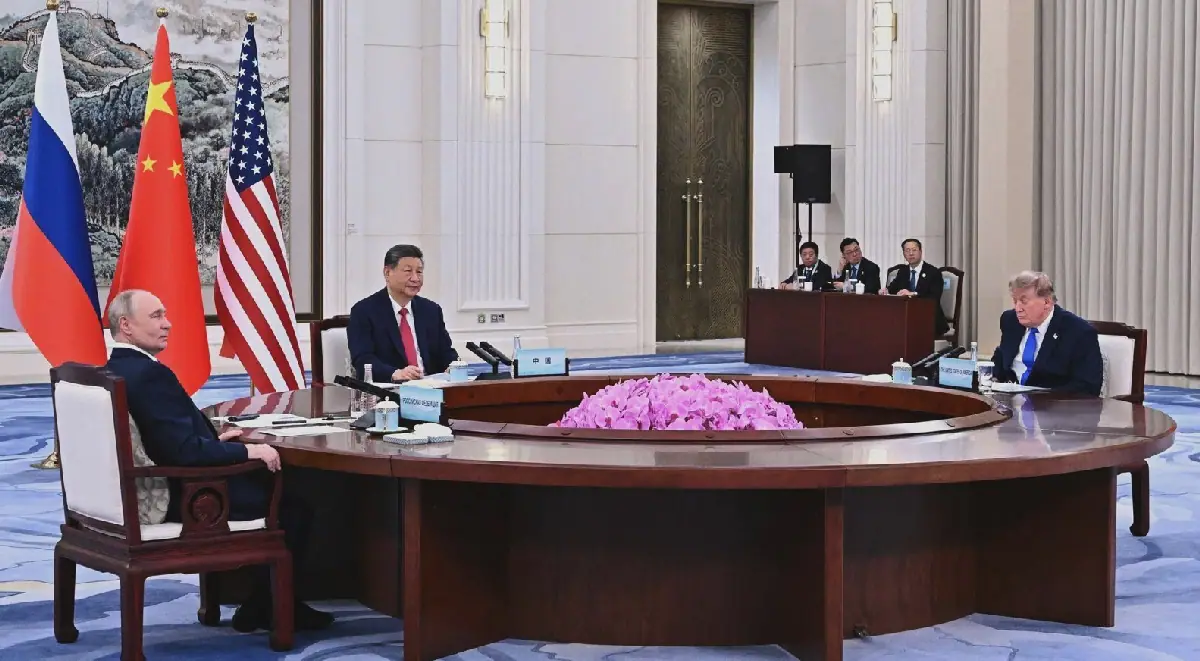
The 1945 Yalta Conference, attended by Franklin D. Roosevelt, Winston Churchill, and Joseph Staline, marked a significant shift in global power dynamics, with the three leaders establishing a new world order and spheres of influence that would impact numerous nations and states for decades to come. The consequences of these arrangements continue to affect several international crises, including those in Palestine and the Korean Peninsula. Over eight decades later, the Shenzhen summit has revived memories of this historic conference, amidst a profoundly changed international landscape.
The current global landscape is characterized by the ongoing Russia-Ukraine war, tensions surrounding Iran and the Strait of Hormuz, the Palestinian question, nuclear balances, and the pursuit of technological supremacy. However, the world has undergone significant changes since 1945, with China emerging as a major economic and technological power, rivaling the United States, and Russia facing the aftermath of its military engagement in Ukraine. The choice of Shenzhen as a summit location holds symbolic significance, representing China's economic and technological transformation and the gradual shift of global gravity towards Asia.
A key difference between the current era and 1945 lies in the nature of power itself. While the United States and Russia maintain significant military and nuclear capabilities, China now wields substantial economic, commercial, and technological leverage. The competition among these three actors extends beyond military matters, encompassing semiconductors, supply chains, global markets, and artificial intelligence. This technology has become a major strategic concern, capable of transforming the economy, work, production, and even the conduct of wars.
In this new balance, Europe appears relegated to the background. Unlike Yalta, where the United Kingdom was represented by Winston Churchill, Europeans currently struggle to project a unified political and strategic voice. Despite its economic weight, the European Union remains divided on crucial issues, including the Ukraine war and its relations with Washington. This fragmentation limits the EU's ability to influence the orientations of the new world order, raising concerns about the future of Ukraine and the potential for a negotiated agreement between major powers without Kiev's meaningful participation.
The Strait of Hormuz crisis highlights the importance of the Gulf region, which extends beyond regional boundaries and has significant implications for the global economy. It would be challenging to envision a future for this region being decided without considering the interests and concerns of its own actors. Similarly, the Palestinian question illustrates the limitations of the current international order, where the geopolitical interests of major powers often take precedence over international law and the rights of peoples. The recurrent blockage of the Security Council, due to the veto power of permanent members, underscores the need for international institution reform.
The experiences of Afghanistan, Iraq, and the Ukraine war have shown that military superiority does not guarantee political victory or sustainable peace. The balance of power is also influenced by hybrid wars, cyberattacks, economic warfare, and information manipulation. Artificial intelligence opens new military and security perspectives but raises questions about human control over strategic decisions. In these circumstances, the Shenzhen summit appears more as an opportunity for leaders to reaffirm their ambitions and consolidate their international image rather than a genuine step towards resolving major global crises.
The critical question is whether the world is heading towards a system dominated by three major powers or a multipolar international order where medium and small states can also defend their interests. While Yalta shaped the post-war world, Shenzhen could symbolize a new stage in the recomposition of international power dynamics. However, the risk remains that peoples may once again become mere pawns in the strategies of major powers. The world does not need a new Yalta to redistribute spheres of influence; it requires a more just international order based on respect for international law, people's sovereignty, and the pursuit of sustainable peace.
Key points
- The Shenzhen summit has drawn comparisons to the 1945 Yalta Conference.
- The current global landscape is shaped by the ongoing Russia-Ukraine war and tensions surrounding Iran.
- Europe appears relegated to the background in the new balance of power.