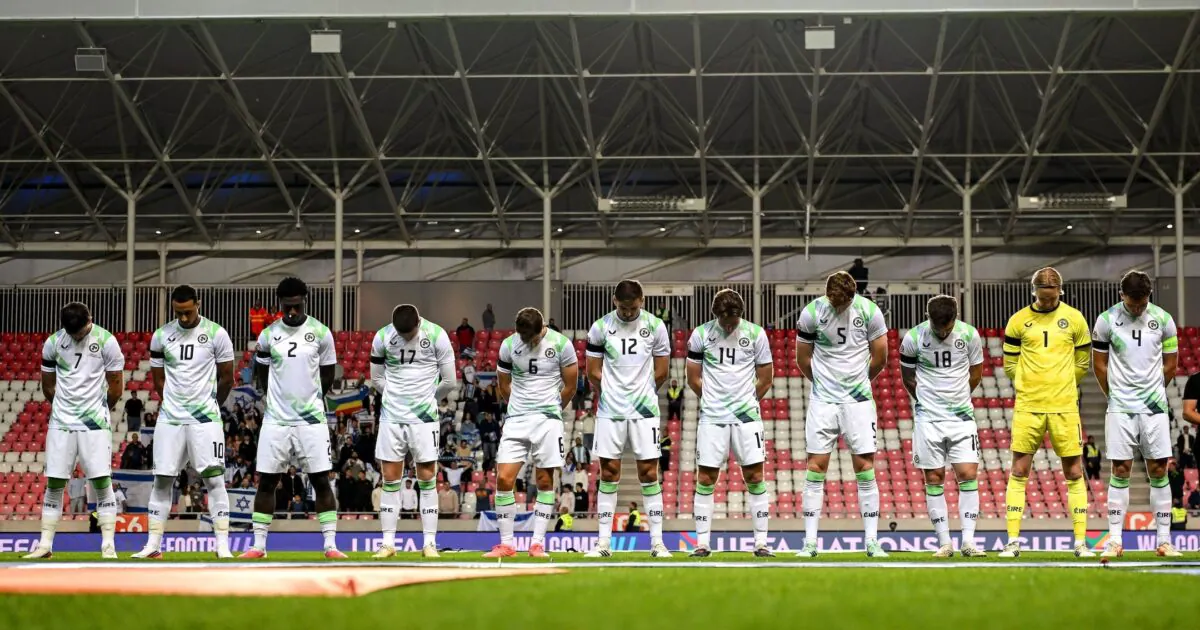
The Republic of Ireland national soccer team secured a 3-0 victory over Israel in a UEFA Nations League B match held in Debrecen, Hungary, on September 25, 2026. The Irish players wore black armbands and bowed their heads during the Israeli national anthem in protest of the Gaza war. The match was marked by intense geopolitical tensions, with the Irish team's actions sparking a strong reaction from Israeli officials. The stadium was mostly empty, with Ireland's soccer federation not reserving tickets for its fans.
The Irish team's decision to boycott pre- and post-game handshakes with the Israeli players was a deliberate gesture of protest. One Irish player declined to participate in the match altogether, citing his personal belief that the killing of innocent people is wrong. The team's coach, Heimir Hallgrímsson, faced questions about the match, saying, "We are not playing with genocide, we are playing against genocide." The Irish team's actions were met with criticism from Israeli officials, who accused them of hypocrisy and ignorance.
The match was part of a long history of icy relations between Ireland and Israel. Ireland became the first member of the European Union to call for an independent Palestinian country in 1980 and was among the first Western European countries to recognize an official Palestinian state in 2024. Israel closed its embassy in Dublin in response. Irish Prime Minister Micheál Martin has rejected claims that his country's sharp criticism of Israel bleeds into antisemitism.
In the months leading up to the match, Ireland's football governing body faced intense pressure to boycott the game. The Football Association of Ireland voted 75-32, with three abstentions, in favor of proceeding with the match, while acknowledging the strength of feeling regarding support for Palestine. The motion also noted that a boycott would come with UEFA sanctions, both financial and competitive. The Irish team itself also held a last-minute vote over whether to participate.
The match was not without controversy, with Israeli Foreign Minister Gideon Sa'ar posting a lengthy tweet referencing the 1939 Irish squad that gave a Nazi salute before a game against the German national team. Sa'ar wrote that Ireland's unique talent for finding itself on the wrong side of history remains intact. The Irish players' actions during the match sparked a strong reaction from Israeli officials, with Israel's football association responding to Hallgrímsson's comments with a post on X.
After the match, Israeli captain Manor Solomon said the Irish players who bowed their heads during the Israeli anthem "don't interest me." Solomon, who plays in the English Championship league, added that Israel is a strong and amazing country with amazing people. The two teams are set to meet again on October 4 in Serbia, this time with Ireland as the "home" team.
The tensions surrounding the match reflect the complex and sensitive nature of the Gaza war and its impact on international sports. The Irish team's actions sparked a heated debate about the role of politics in sports and the responsibilities of athletes as representatives of their countries. The match has also raised questions about the future of relations between Ireland and Israel, both on and off the field.
Key points
- Ireland's soccer team beats Israel 3-0 in UEFA Nations League B match amid Gaza war tensions
- Irish players wore black armbands and bowed their heads during the Israeli national anthem in protest
- The two teams are set to meet again on October 4 in Serbia, this time with Ireland as the "home" team